
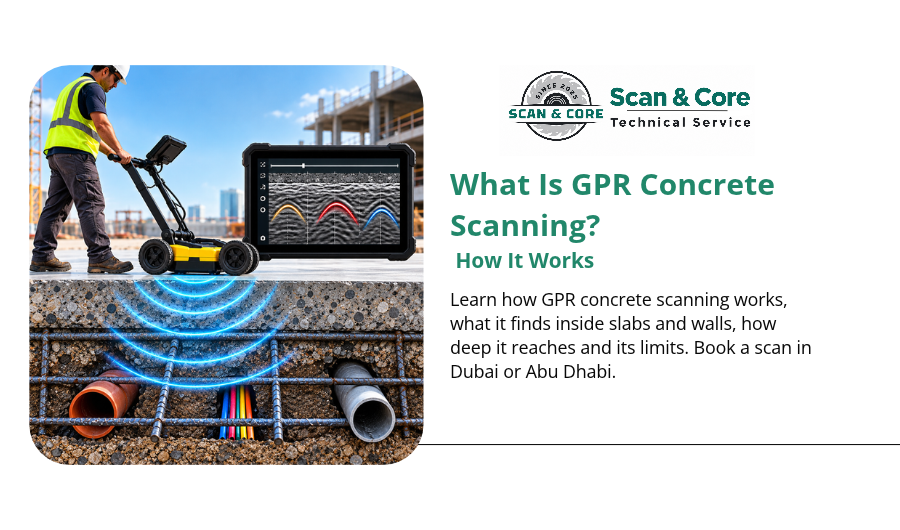
Concrete looks solid and uniform from the outside. Inside, it’s crowded. A typical slab in a Dubai tower carries layers of rebar, post-tension cables, electrical conduits and sometimes plumbing, all hidden behind a plain grey surface. GPR concrete scanning lets you see that hidden layout before anyone drills, cuts or cores. Here’s what the technology is, how it works, what it can find and where its limits are. What GPR stands for GPR means ground penetrating radar. The name comes from its original use: looking into soil for pipes, cables and buried structures. The same principle works in concrete. Dedicated concrete scanners use higher-frequency antennas than soil units, which gives sharper detail at the shallower depths found in slabs, walls and columns. How GPR works Think of it like an echo. 1. The antenna sends a pulse. The scanner is rolled across the concrete surface. As it moves, the antenna fires very short pulses of radio energy into the concrete, thousands of times per second. 2. The pulse hits something different. Radar energy travels through concrete until it meets a material with different electrical properties. Steel, plastic conduit, air voids and the bottom of the slab all behave differently from the concrete around them. 3. Part of the signal bounces back. At each of those boundaries, some energy reflects back up to the antenna. Steel reflects strongly. Plastic and air reflect more weakly, but they still show. 4. The scanner times the echo. The system measures how long each reflection took to return. Longer time means deeper target. Combined with the known speed of radar through concrete, that gives a depth reading. 5. The data builds an image. As the scanner rolls along, those readings stack up into a cross-section of the concrete, displayed on screen in real time. What a GPR scan image looks like The screen doesn’t show a neat picture of a bar. It shows a curved shape, a bit like an upside-down “U”, called a hyperbola. That shape forms because the antenna “sees” a target before it’s directly above it, while it’s overhead, and after it has passed. The peak of the curve marks the target’s exact position and depth. A row of evenly spaced hyperbolas usually means a rebar mat. A single hyperbola at an unusual depth, or with a draped profile across a slab, can point to a post-tension tendon. Reading those patterns correctly is where technician experience matters most. What GPR concrete scanning can find A good scan can locate: That last point is useful. Because GPR works from a single face, you don’t need access to the underside of a slab to know how thick it is or what’s inside. How deep and how accurate is it? It depends on the antenna. Higher frequency gives finer detail but less depth. Lower frequency reaches deeper but with less resolution. For a sense of scale, a widely used handheld concrete scanner with a 2.7 GHz antenna reaches up to about 60cm deep, with horizontal measurement precision of around 1.2mm according to the manufacturer’s specifications (GSSI). That’s plenty for most slabs, walls and columns in residential and commercial buildings. Depth readings are usually accurate to within a small margin once the scanner is calibrated to the concrete on site. That calibration step is one of the things that separates a reliable scan from a rough guess. What GPR can’t do GPR is powerful, but it isn’t magic. Know the limits before you rely on it: GPR vs other methods GPR isn’t the only way to look inside concrete, but it’s the most practical for most sites. It needs access to one side only, gives results on the spot and uses no radiation, so nobody has to clear the area while scanning. X-ray imaging can give sharper pictures in some situations, but it needs access to both sides and a safety exclusion zone. We’ll compare the two properly in a separate post. What happens on a scanning job A typical visit looks like this: Why it matters on Dubai projects Dubai’s building stock includes a lot of post-tensioned slabs, dense reinforcement and embedded services, and a lot of work happens inside occupied buildings. Hitting a PT cable or live conduit is dangerous, expensive and disruptive. A scan takes a fraction of the time of a repair. It’s the step that makes safe concrete cutting and coring possible, and it gives your structural engineer real data to work with. Book GPR concrete scanning in Dubai Scan and Core provides GPR concrete scanning across Dubai and Abu Dhabi, with on-surface marking and a clear report after every job. If you’re also cutting or coring, we can scan and cut in the same visit. Contact Scan and Core to book a scan, or call +971 56 861 9006.
