
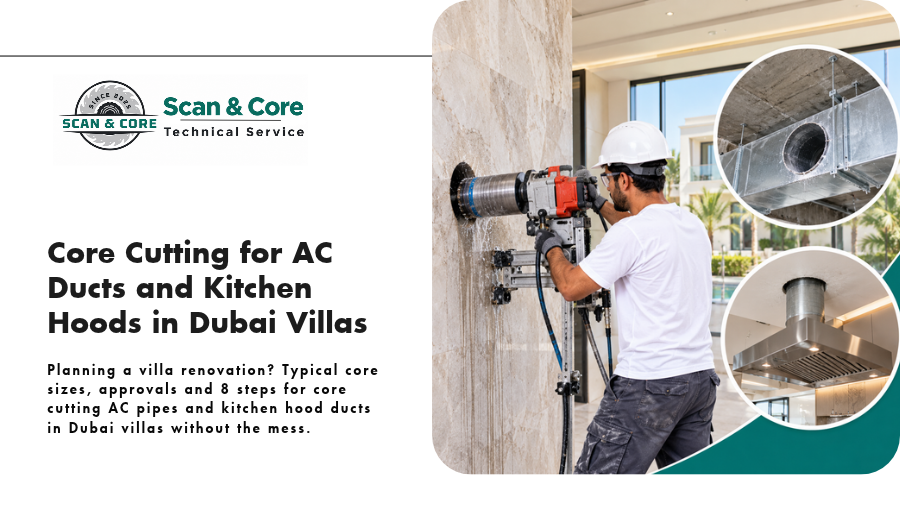
Dubai villa owners are renovating rather than moving. Demand for luxury villa renovations has risen an estimated 35 to 50% over the past five years, and many buyers now purchase with a renovation already planned (Zawya, August 2026). Two jobs come up in almost every villa renovation: new AC routes and a new kitchen hood. Both need clean holes through walls or slabs. Here’s how core cutting for each works, step by step. What sizes are we talking about? These are typical ranges. Your MEP contractor’s drawings set the final size. Service Typical pipe or duct Typical core size Split AC refrigerant pipes and drain Pipe pair plus drain 65 to 82mm AC condensate drain only 32mm pipe 52mm Kitchen hood duct (most homes) 150mm round 162 to 200mm Larger hood or commercial-style range 200 to 250mm round 225 to 300mm Fresh air or extract duct 150 to 200mm 200 to 225mm The core is usually a little bigger than the pipe or duct, so there’s room for a sleeve and sealant. Step 1: Decide where the duct or pipe will go Mark the route on a plan before anyone drills. Think about: Step 2: Check the approvals Small cores for AC pipes often only need community management approval. Larger openings, anything through a roof slab, and changes to the kitchen layout or facade may need a permit from Dubai Municipality, Trakhees or the Dubai Development Authority depending on your area. Our permits and approvals team can tell you what applies. Step 3: Find out what the wall or slab is made of Villa walls are often blockwork, while slabs, beams and columns are reinforced concrete. Blockwork is quicker to core but needs care so the blocks don’t crack. Concrete needs scanning first. If the route passes near a beam or column, stop and ask an engineer. Those are structural and usually off-limits. Step 4: Scan the location Villa slabs and walls carry rebar, electrical conduits and water pipes you can’t see. GPR concrete scanning marks them on the surface so the core can be moved slightly to avoid them. For a roof slab, the scan also shows slab thickness, which you’ll need to know before drilling. Step 5: Protect the room Core cutting uses water to cool the bit and control dust. Inside a finished villa, the crew should: Step 6: Cut the core The rig is fixed to the wall or slab with an anchor or vacuum base, and the diamond bit cuts through. For an external wall, the crew may drill from inside and finish carefully on the outside so the facade doesn’t chip. For AC pipes, a slight downward slope toward the outside helps condensate drain away. Step 7: Sleeve and seal Fit a sleeve through the hole, install the pipe or duct, then seal both sides. On external walls, use a weatherproof sealant and an external cowl or grille on hood ducts. On roof slabs, restore the waterproofing around the penetration. A roof core that isn’t sealed properly will leak in the first heavy rain. Step 8: Clean up and check The crew removes the core, slurry and protection. Check the hood or AC works, look for gaps around the sleeve, and check the outside finish. Common villa mistakes to avoid Book villa core cutting in Dubai Scan and Core handles villa core cutting across Dubai and Abu Dhabi. We scan, protect your home, core cleanly and leave the space tidy. See our concrete cutting and coring services. Contact Scan and Core to book a visit, or call +971 56 861 9006.
