
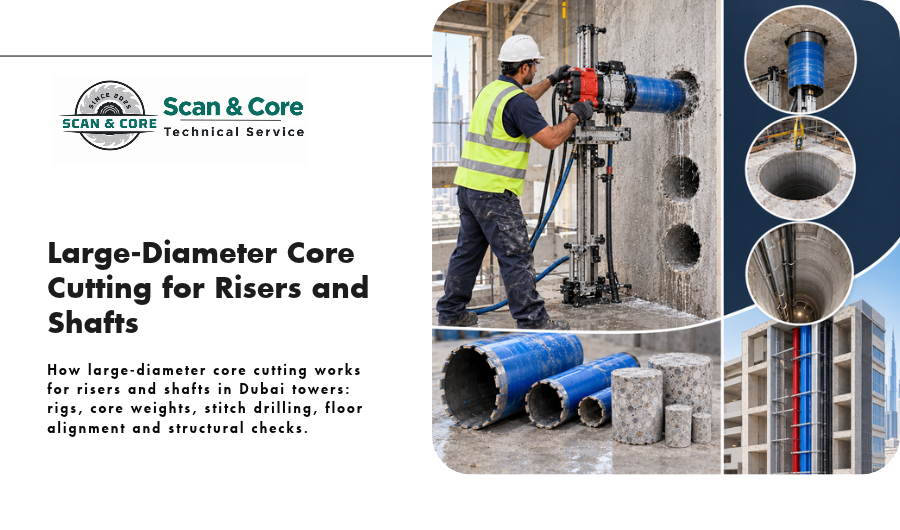
Howdy, asim Most cores are small: 52mm for an AC drain, 152mm for a soil pipe. But towers, hospitals and malls also need big vertical routes for services. Main drainage stacks, chilled water risers, kitchen extract shafts and cable risers can all need openings several hundred millimetres across, through slab after slab. Dubai’s buildings keep getting bigger. The total permitted built-up area in Q1 2026 approached 3.9 million square metres, up 48% on the year before (AGBI). More floor area means more risers, and more large-diameter cores. Here’s how large-diameter core cutting works and what makes it different. What counts as “large-diameter”? There’s no fixed line, but in practice anything over about 200mm is treated differently from everyday coring. Large cores often range from 250mm to 600mm, and specialist rigs can go well beyond that for shafts and piling work. At that size, everything gets bigger: the rig, the power, the water, the weight of the core and the impact on the slab. How it’s different from small coring More powerful rigs Large bits need high torque at low speed. Crews use heavy-duty electric or hydraulic core drills mounted on rigid stands. Small handheld drills simply can’t turn a 500mm bit. Stronger fixing The rig must be anchored firmly to the slab, usually with a mechanical anchor. A vacuum base that holds a small rig isn’t enough for the forces involved. Heavy cores A core’s weight rises fast with diameter. A 300mm core through a 250mm slab weighs about 42kg. A 600mm core through the same slab weighs around 170kg. These can’t be caught by hand. They need lifting points, retaining bolts or support from below. More water and slurry Bigger bits need more cooling water and produce more slurry. Containment matters even more, especially if the floors below are finished or occupied. Bigger structural impact Removing a 600mm disc of concrete is a structural change, not a small penetration. Engineers usually need to check it, and some slabs need strengthening around the opening. One big core or several smaller ones? There are three common ways to form a large riser opening: Single large core. Best for round openings like drainage stacks. One clean cut, smooth sides. Stitch drilling. A ring of overlapping smaller cores around the outline, with the middle removed afterwards. Useful when a large single bit won’t fit or access is tight. The edges are scalloped, so they may need trimming. Corner cores plus sawing. For square or rectangular shafts, cores are drilled at each corner and a wall saw cuts between them. This gives straight sides and clean corners with no overcuts. The right method depends on the shape you need, the slab thickness and the space around the opening. How a riser coring job runs 1. Check the design. The engineer confirms each opening is safe, and whether trimming bars or strengthening are needed. Start with a structural analysis. 2. Scan every floor. Each slab can have different reinforcement and services. GPR concrete scanning is done at every level, not just the first one. 3. Align the floors. Riser openings must line up vertically. Survey setting out or a plumb line keeps every core in the same position from floor to floor. 4. Set up and anchor. The rig is fixed and levelled. The area below is barricaded. 5. Cut and remove. The core is cut, secured and lifted out safely. 6. Seal or strengthen. Openings are protected until services go in, then firestopped. Any strengthening is carried out as designed. Where large-diameter coring is used Plan your riser openings Scan and Core handles large-diameter core cutting, scanning and structural checks across Dubai and Abu Dhabi. See our concrete cutting and coring services. Contact Scan and Core with your riser layout, or call +971 56 861 9006.
