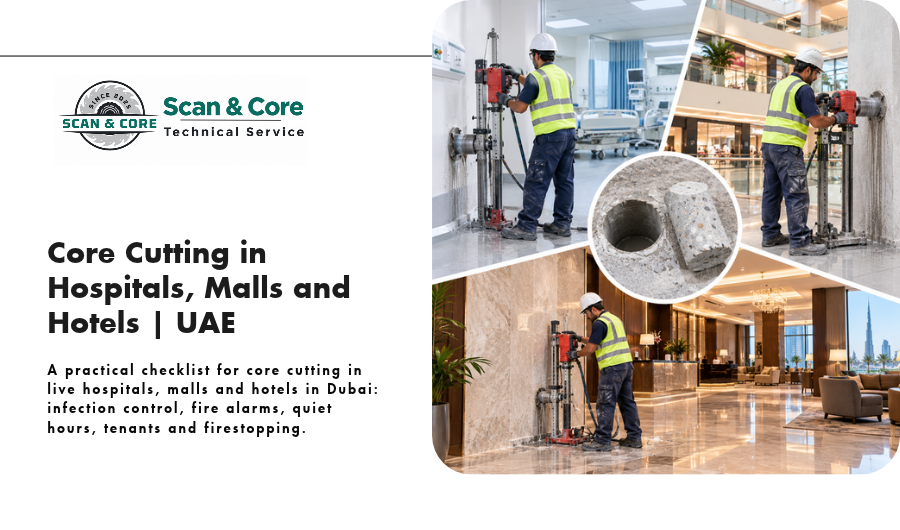
Some buildings never close. Hospitals treat patients around the clock, malls trade seven days a week, and hotels are full of guests trying to sleep.
Dubai’s hotel sector alone had 158,700 rooms across 770 establishments at the end of 2025, with another 4,600 rooms due in 2026 (Khaleej Times). Every new fit-out, kitchen upgrade and MEP change in these buildings means core cutting with people nearby.
Use this checklist to plan core cutting in live buildings without disrupting the people inside.
For every live building
☐ Scan every core location. Live buildings are packed with services. GPR concrete scanning marks rebar, PT cables and conduits before drilling.
☐ Get facilities management approval with a method statement, risk assessment and drawings showing each core.
☐ Check what’s below. Find out what room sits under each slab core before you drill.
☐ Plan water and slurry control. Use collection rings, wet vacuums and protection on the floor below.
☐ Plan fire alarm coordination. Water mist and dust can trigger smoke detectors. Agree with facilities whether detectors in the area need to be isolated, and who restores them afterwards.
☐ Firestop every penetration. Cores through fire-rated slabs and walls must be sealed with an approved firestop system once services are installed.
☐ Agree the working hours in writing.
Hospitals
☐ Follow infection control rules. Many hospitals require dust barriers, sealed work zones and sometimes negative air pressure. Ask for the hospital’s infection control requirements before you quote.
☐ Map critical rooms above and below. Operating theatres, ICUs and imaging rooms may be off-limits or need special timing.
☐ Check for sensitive equipment. Imaging and lab equipment can be sensitive to vibration. Diamond coring is low-vibration, but facilities should still confirm what’s nearby.
☐ Identify medical gas lines. Oxygen and other gas lines must be located and protected. The hospital’s engineering team should confirm before drilling.
☐ Keep corridors clear. Patient routes and emergency access can’t be blocked, even briefly.
Malls
☐ Work outside trading hours. Most malls only allow noisy work overnight or before opening.
☐ Coordinate with tenants. A core in a slab may come out in a shop ceiling below. Tenants need notice and their stock needs protecting.
☐ Barricade public areas. If any work is visible to shoppers, use hoarding and signage.
☐ Plan the exit route. Cores, slurry and equipment need to leave through service corridors, not public malls.
☐ Protect finishes. Mall floors and ceilings are expensive. Cover them and check them before and after.
Hotels
☐ Respect quiet hours. Hotels usually limit noisy work to daytime hours that suit guests.
☐ Block rooms above and below when coring through guest floors, or schedule the work when they’re empty.
☐ Check the events calendar. Ballrooms, meeting rooms and restaurants near the work area may have bookings.
☐ Coordinate kitchen work. Hotel kitchen upgrades often need large cores for extract ducts. Plan around service times.
☐ Keep the guest experience clean. Equipment moves through back-of-house routes, and any guest-facing area is left spotless.
Before you leave site
☐ All cores removed and slurry cleaned up
☐ Fire alarm detectors restored and checked with facilities
☐ Temporary seals in place on any holes not yet used
☐ Floors and rooms below inspected for water or debris
☐ Records of every core handed to facilities for their drawings
Plan your live-building core cutting
Scan and Core cores in occupied buildings across Dubai and Abu Dhabi, working around facility rules, quiet hours and tenants. See our concrete cutting and coring services.
Contact Scan and Core to plan your job, or call +971 56 861 9006.