A pipe needs to cross a corridor and a beam is in the way. Someone suggests just coring through it. It’s only a small hole, after all.
That’s when expensive mistakes start. Beams and columns carry the building, and the rules for cutting them are stricter than for slabs or partition walls.
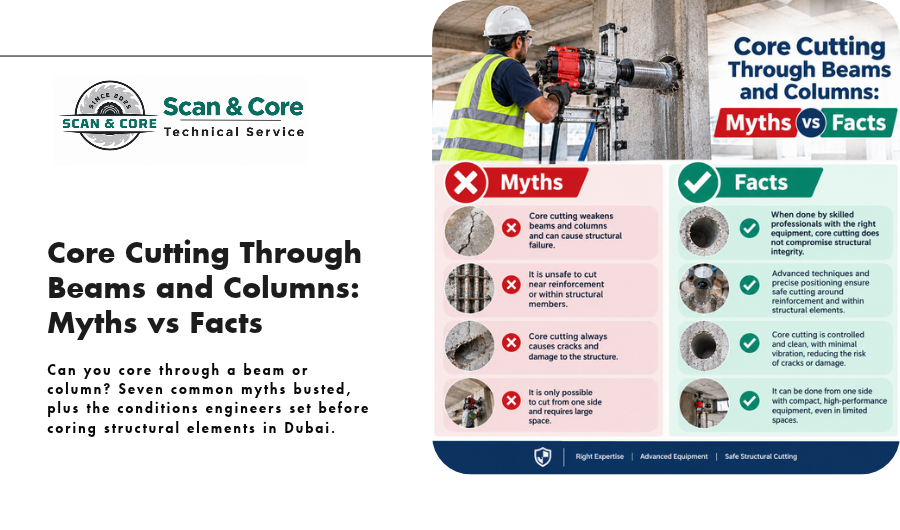
Here are the myths we hear most, and what’s actually true.
Myth 1: “A small core in a beam doesn’t matter”
The truth: Size matters, but so does position. A small core in the wrong spot can cut a main bar or stirrup, or remove concrete the beam needs near its supports. Every core in a beam should be checked by a structural engineer, however small.
Myth 2: “Anywhere along the beam is the same”
The truth: Beams work differently along their length and depth.
- Near columns and supports, beams carry the highest shear forces. Cores here are usually avoided.
- At the top and bottom, beams carry the main compression and tension. The bottom usually holds the main tension bars.
- Around mid-depth, away from supports, stresses are often lower. That’s typically where engineers prefer any approved openings to go.
Your engineer decides the exact zone, based on the beam’s design and loads.
Myth 3: “If the scan shows no rebar, it’s safe”
The truth: Missing the rebar is necessary, but it isn’t enough. Removing concrete also reduces the beam’s capacity, especially in the compression zone. A scan tells you where the steel is. Only an engineer can tell you whether the beam can afford to lose that concrete.
Myth 4: “Columns can take a small core”
The truth: Columns are the most critical elements in most buildings. They carry loads from every floor above. Coring a column for services is generally not allowed. The main exception is taking small test cores for strength checks, and even that needs an engineer’s approval and proper repair afterwards. See our concrete testing services.
Myth 5: “A shear wall is just a wall”
The truth: Shear walls and core walls resist wind and lateral loads. They’re structural, just like columns. Coring them needs the same engineering check. Partition walls and blockwork infill are different, but you need to confirm which one you’re dealing with first.
Myth 6: “We can patch it afterwards”
The truth: Filling a hole with grout restores the surface, not the strength. Cut bars stay cut. If an unapproved core has damaged a beam or column, the fix is usually engineered strengthening, such as carbon fibre wrapping or steel plating. That costs far more than rerouting the pipe would have.
Myth 7: “The last contractor did it, so it must be fine”
The truth: Previous cores don’t prove anything. They may have been unapproved, or approved for a different load. Every new core needs its own check, especially if older cores are already nearby.
So when is coring a beam allowed?
It can be allowed when all of these are true:
- A structural engineer has approved it, in writing, for that exact location and size.
- The core sits in the zone the engineer specifies, usually away from supports and near mid-depth.
- The diameter is limited relative to the beam’s depth, as set by the engineer.
- The location is scanned with GPR concrete scanning, and no main bars or stirrups are cut.
- Any strengthening the engineer requires is carried out.
- The hole is sealed or firestopped once the service is installed.
Some new buildings have sleeves cast into beams during construction for this exact reason. Always check the drawings for existing sleeves before coring a new hole.
The better question
Before asking “can we core this beam?”, ask “can the service go another way?” Under the beam, through a nearby slab, or along a different route is often cheaper and faster than an engineered core.
If there’s no other route, start with a structural analysis.
Talk to Scan and Core
Scan and Core combines scanning, structural assessment and core cutting across Dubai and Abu Dhabi, so the check and the cut happen as one job.
Contact Scan and Core before you core a structural element, or call +971 56 861 9006.