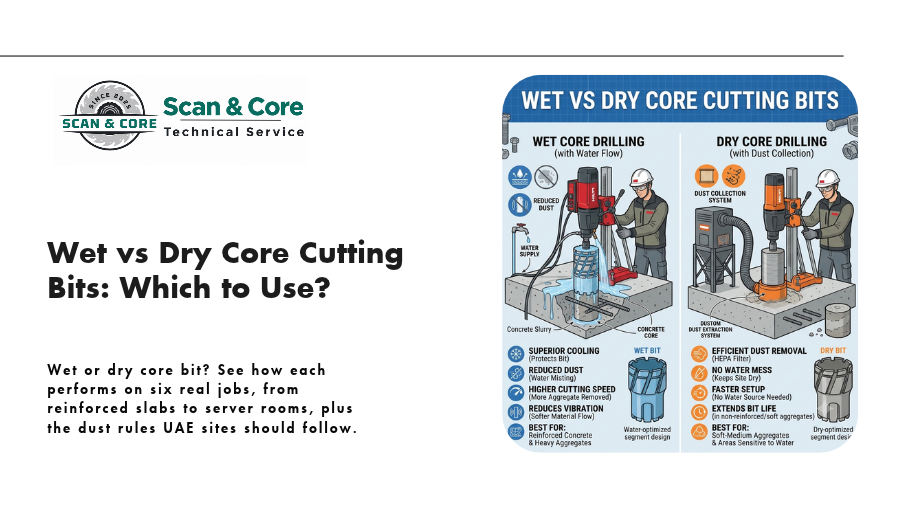
Diamond core bits come in two main types: wet bits, which need water flowing to the cutting face, and dry bits, which are built to run without it. Using the wrong type wastes bits, slows the job and can create a lot of dust.
Rather than a long list of pros and cons, this guide looks at what each bit is built to do, then puts both through six common jobs on Abu Dhabi and Dubai sites.
What makes a bit “wet” or “dry”
Wet bits are designed to be cooled by water. The water also flushes cutting debris out of the hole and traps dust in slurry. Their segments are usually brazed or laser-welded to the barrel and use bonds suited to hard, reinforced concrete.
Dry bits are designed to cope with the heat of cutting without water. They’re usually laser-welded, because brazed joints can soften with heat, and they often have slots or features that help clear dust. They rely on dust extraction instead of water.
One rule matters more than anything else: never run a wet bit dry. Without water, the segments overheat. They can glaze, crack or detach from the barrel. Some dry bits can be used with water, but always check the manufacturer’s instructions.
How they compare
| Wet bits | Dry bits | |
| Best material | Reinforced concrete, dense stone | Blockwork, brick, softer masonry |
| Rebar | Handles it | Struggles, wears fast |
| Diameter range | Small to very large | Mostly small to medium |
| Depth | Deep cores | Shallower holes |
| Bit life in concrete | Longer | Shorter |
| Dust | Very little | Needs extraction |
| Water and slurry | Yes, must be contained | None |
| Use near live electrics | Needs careful protection | Easier to manage |
Six jobs: which bit wins?
Job 1: 152mm core through a 250mm reinforced slab
Wet. Reinforcement and depth demand water cooling. A dry bit would wear fast and risk overheating.
Job 2: 65mm hole through a blockwork wall in a finished villa bedroom
Dry, with dust extraction. No water means no slurry on the carpet or furniture, and blockwork is the material dry bits are made for.
Job 3: Holes next to a live electrical panel
Dry, if the material allows it. Water near live equipment is a serious hazard. Where the wall is masonry, dry coring with extraction is safer. If it’s reinforced concrete, the area must be isolated and protected before wet coring.
Job 4: 300mm core for a riser in a concrete core wall
Wet. Large diameter, heavy reinforcement and thick concrete all point to a wet bit on a rig.
Job 5: Small cable holes in a server room
Dry where possible. Water and slurry in a data room create risk. If the slab is reinforced concrete and must be cored wet, plan water containment carefully with the facility’s team.
Job 6: Overhead core in a car park soffit
Wet, with a water collection ring. Soffits are reinforced concrete, and dry coring overhead would rain dust onto the operator.
The dust question
Concrete and masonry contain crystalline silica. Breathing in the fine dust can cause serious lung disease over time. For comparison, the US Occupational Safety and Health Administration sets a limit of 50 micrograms per cubic metre over an 8-hour day for respirable crystalline silica in construction (OSHA). Many international contractors in the UAE use similar benchmarks.
That’s why dry coring should never mean dusty coring. Dry work needs a shroud and a proper extraction vacuum. Wet work controls dust at the source, as long as the slurry is collected before it dries.
Quick decision rule
- Reinforced concrete, deep or large? Wet.
- Masonry, small, inside a finished space? Dry with extraction.
- Near live electrics or sensitive equipment? Dry if possible, wet only with isolation and protection.
- Not sure what the wall is made of? Find out first. Scanning and a test hole will tell you.
Get the right bit for your job
Scan and Core carries wet and dry coring equipment for jobs across Abu Dhabi and Dubai, and scans every location with GPR concrete scanning first. See our concrete cutting and coring services.
Contact Scan and Core to plan your job, or call +971 56 861 9006.