Jebel Ali Free Zone is one of the busiest industrial and logistics hubs in the region. By the end of the first half of 2026, more than 11,650 companies were operating there, and warehouses and stores were 98% occupied (Voice of Emirates).
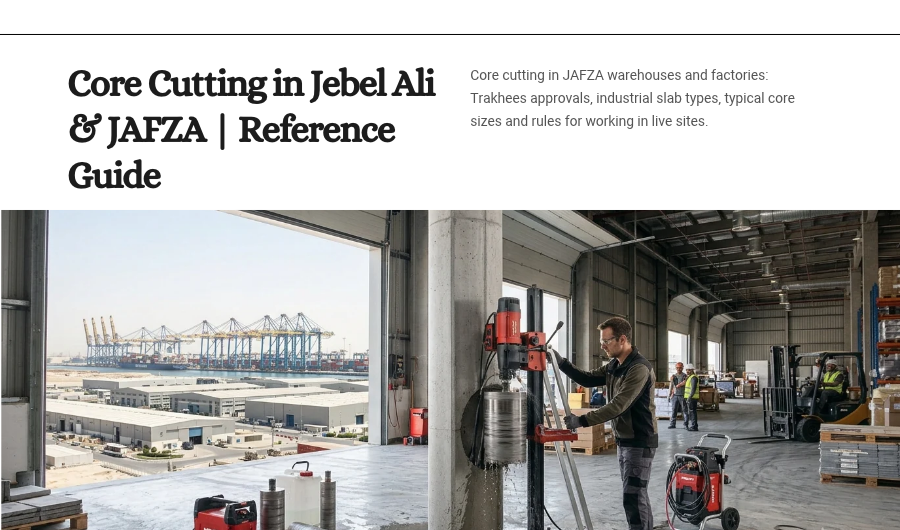
High occupancy means most core cutting in JAFZA happens inside working warehouses, factories and cold stores. This reference guide covers the approvals, slab types, typical core sizes and site rules that matter there.
Approvals in JAFZA
JAFZA follows a different approval route from mainland Dubai. Construction and modification work in Trakhees zones, including JAFZA, needs a Trakhees CED permit before work starts, and many jobs also need an EHS NOC (Dar Al Naseeb, May 2026).
In practice, check three things before coring:
| Approval | Who issues it | When it’s needed |
| Landlord or lessor approval | Building owner or JAFZA lessor | Almost always |
| Trakhees CED permit | Trakhees | Structural changes, new openings, MEP modifications |
| EHS NOC | Trakhees EHS | Work with safety or environmental impact |
Requirements vary by scope. If you’re unsure, our permits and approvals team can check what applies.
Industrial slabs: what you’re coring through
| Slab type | Where you find it | What to watch for |
| Thick ground-bearing slab | Warehouses, factories | Depth: cores can be deep and slow |
| Steel-fibre reinforced slab | Many modern warehouses | Fibres can make GPR scans harder to read |
| Mesh or bar reinforced slab | Older units, mezzanines | Rebar layers to avoid |
| Post-tensioned slab | Some warehouses and multi-level units | Tendons must be located before any core |
| Cold store floor | Food and pharma storage | Insulation and underfloor heating pipes below the slab |
| Mezzanine or upper slab | Offices, storage decks | Space below must be protected |
Cold stores need special care. Many cold store floors have heating pipes or cables under the slab to stop the ground freezing. Coring into them can cause serious damage. Always check the floor design first.
Typical JAFZA core cutting jobs
| Job | Typical core size | Notes |
| Racking anchor holes | Small drilled holes | Scan for rebar and slab joints |
| Floor drains and trench outlets | 102 to 152mm | Check falls and drainage route |
| Sprinkler mains (DN100 to DN200) | 152 to 300mm | Many warehouses use large sprinkler systems |
| Compressed air and process pipes | 65 to 127mm | Often run through mezzanines |
| Electrical and data routes | 52 to 127mm | Plan spare capacity for automation |
| EV and forklift charging cables | 52 to 82mm | Common in fleet and logistics sites |
| Dock leveller and machine base openings | Corner cores plus saw cutting | Usually needs a structural check |
| Core samples for testing | 100mm or as specified | For slab strength checks |
Large openings, machine bases and new pits should be checked with a structural analysis first.
Working in a live warehouse
With most JAFZA units occupied, plan for:
- Forklift and truck traffic. Barricade the work area and agree a traffic plan with the site.
- Stock protection. Cover racking and goods near the core. Slurry and dust damage stock.
- Shift patterns. Many sites run around the clock. Agree when noisy work can happen.
- Fire systems. Water mist and dust can set off detectors. Coordinate isolation with the site’s fire team.
- Clean floors. Food, pharma and electronics sites have strict hygiene rules. Contain all slurry.
- Site inductions. Most JAFZA sites require inductions and permits to work before crews start.
Scanning industrial slabs
GPR concrete scanning locates rebar, tendons, conduits and slab joints before drilling. Steel-fibre slabs can make readings less clear, so an experienced technician matters. A small test core can also confirm slab depth and build-up.
Book core cutting in JAFZA
Scan and Core provides scanning, core cutting and saw cutting for warehouses, factories and logistics sites in Jebel Ali and across Dubai. See our concrete cutting and coring services.
Contact Scan and Core with your site details, or call +971 56 861 9006.