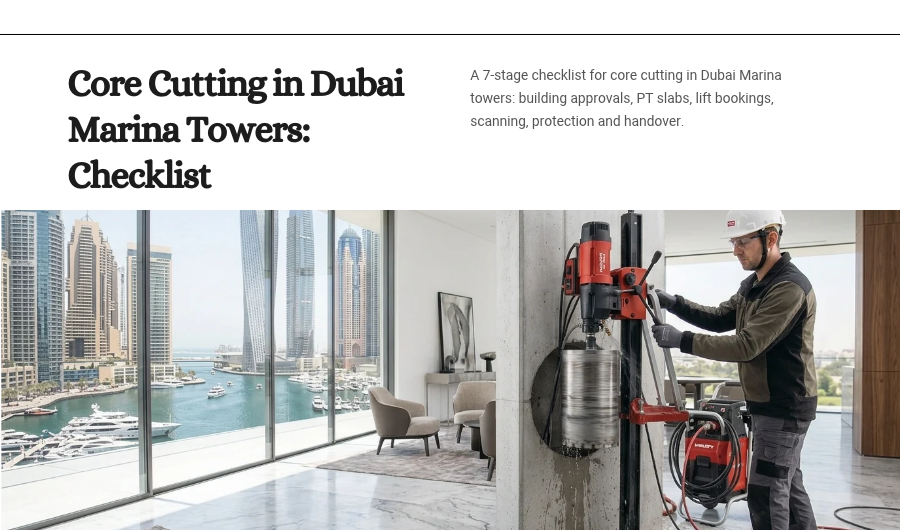
Dubai Marina is one of the densest high-rise districts in the city. Apartments are renovated, offices are fitted out and building systems are upgraded all the time, and almost every job needs a core somewhere.
Towers also have their own rules. Building managers decide when you can drill, where you can go and what paperwork you need. And under Dubai’s new building quality law, Law No. 3 of 2026, owners must appoint licensed engineering offices, keep up periodic maintenance and hold a Quality and Safety Certificate for their buildings (Al Tamimi). Unapproved holes in a tower’s structure are exactly what that law is designed to catch.
Use this checklist to plan core cutting in a Dubai Marina tower.
Stage 1: Approvals
☐ Building management approval with a method statement, risk assessment and marked-up drawings
☐ Owners’ association or landlord consent, if required by the building
☐ Authority permit, if the work changes the structure, layout or MEP systems. Our permits and approvals team can confirm
☐ Structural engineer’s approval for any core near beams, columns, shear walls or slab edges. Start with a structural analysis
☐ Contractor insurance and trade licence ready to show building management
Stage 2: Know the tower
☐ Assume post-tensioned slabs until the drawings or a scan show otherwise. Many towers use PT slabs, and a cut tendon is a serious structural problem
☐ Get the slab and MEP drawings from building management if available
☐ Find out what’s directly below each slab core. It’s usually someone else’s apartment or office
☐ Check for existing sleeves or spare risers before coring new holes
Stage 3: Booking the building
☐ Approved working hours for noisy work, in writing
☐ Service lift booking for equipment and debris
☐ Access to the unit below, arranged with the neighbour or building management
☐ Fire alarm coordination, as water mist and dust can trigger detectors. Agree isolation and reinstatement with the building’s fire team
☐ Loading bay and parking for the crew’s vehicle
Stage 4: Scanning
☐ Scan every core location with GPR concrete scanning
☐ Mark tendons, rebar and conduits on the surface with a clear legend
☐ Move cores to clear zones before drilling, not after hitting something
☐ Keep the scan report for building management and your records
Stage 5: Protecting the tower
☐ Floor and furniture protection in the unit
☐ Corridor and lift protection along the equipment route
☐ Water collection at every core, with wet vacuums on standby
☐ Ceiling protection in the unit below, with someone checking it during drilling
☐ No slurry in drains. Collect it and remove it from the building
Stage 6: Coring
☐ Rig-mounted drill for reinforced slabs and walls
☐ Core secured before breakthrough, so it doesn’t drop into the unit below
☐ Controlled feed near breakthrough, to avoid spalling the neighbour’s ceiling
☐ Stop immediately if steel is hit unexpectedly, and consult before continuing
Stage 7: Handover
☐ Cores and slurry removed from the building
☐ Fire alarms reinstated and confirmed with the fire team
☐ Holes sleeved and firestopped once services are installed
☐ Unit below inspected and signed off
☐ Records updated with every new core location for building management
Why towers need extra care
A villa core affects one home. A tower core can affect the neighbour below, the building’s fire separation, its structure and its compliance record. Getting the paperwork, scanning and protection right is part of the job, not an extra.
Book core cutting in Dubai Marina
Scan and Core handles core cutting in occupied towers across Dubai Marina and the rest of Dubai, working to building management rules from approval to handover. See our concrete cutting and coring services.
Contact Scan and Core to plan your job, or call +971 56 861 9006.