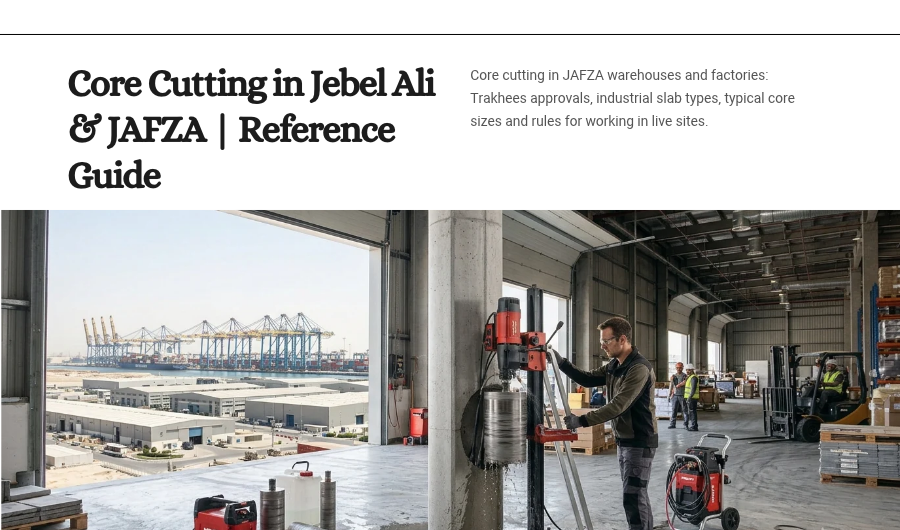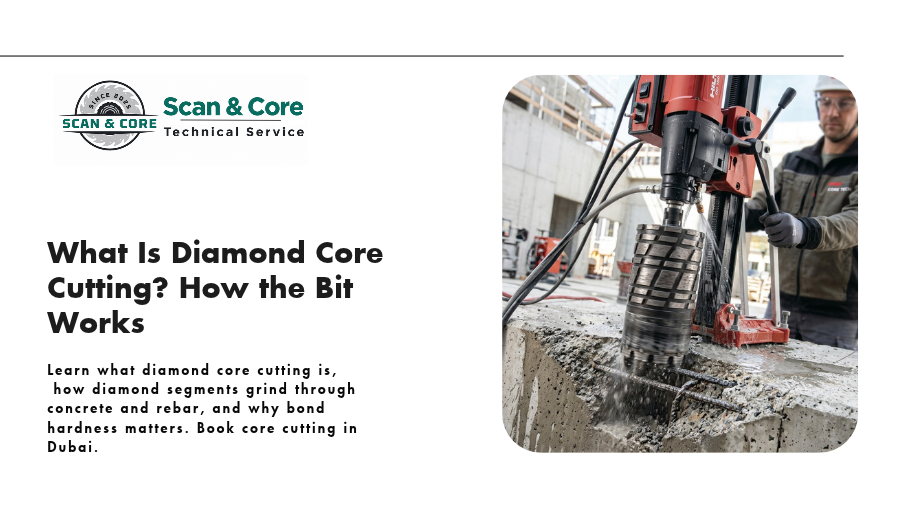
Diamond core cutting is the method used to make clean, round holes through concrete, masonry and stone. A hollow drill bit tipped with industrial diamonds spins against the surface, grinds a thin ring through the material, and leaves a solid cylinder of concrete, the core, that is pulled out in one piece.
It’s how almost every pipe, duct and cable gets through a slab or wall in a modern Dubai building. But what makes a diamond bit work? Here’s a look inside the tool.
The anatomy of a diamond core bit
A core bit has three main parts.
1. The barrel. A hollow steel tube. Its diameter sets the size of the hole, and its length sets how deep you can drill in one pass. The core collects inside the barrel as you drill.
2. The segments. Small rectangular blocks fixed around the cutting end of the barrel. These do the actual cutting. They’re attached by brazing or laser welding.
3. The connection. A threaded end that screws onto the drill motor. Larger bits commonly use a 1¼” thread, and smaller bits often use ½”.
What’s inside a segment
Each segment is made of two things:
- Synthetic diamond crystals, the cutting points
- A metal bond, also called the matrix, that holds the diamonds in place
The diamonds are scattered through the whole segment, not just on the surface. That detail matters, as you’ll see below.
How a diamond bit actually cuts
It’s a common belief that diamond bits slice through concrete like a knife. They don’t. They grind.
- Exposed diamonds scratch the concrete. As the bit spins, the tips of the diamonds standing proud of the bond scrape away tiny particles.
- The bond wears down. Concrete is abrasive, so the metal bond around the diamonds slowly wears away too.
- Old diamonds fall out. Worn diamonds lose their grip and drop out.
- New diamonds are exposed. As the bond wears, fresh diamonds underneath appear and carry on cutting.
This cycle makes the bit self-sharpening. As long as the bond wears at the right rate, there are always sharp diamonds at the cutting face.
Why bond hardness matters
The bond has to wear at the right speed for the material being cut. The general rule is the opposite of what most people expect:
- Hard, dense concrete needs a softer bond. Hard concrete isn’t abrasive enough to wear a hard bond, so new diamonds wouldn’t be exposed.
- Soft, abrasive material needs a harder bond. Abrasive materials like some blockwork wear the bond fast, so a harder bond stops the bit wearing out too quickly.
If the bond is too hard for the material, the diamonds go blunt and the segment surface turns smooth and shiny. This is called glazing, and the bit stops cutting. If the bond is too soft, the bit cuts well but wears out quickly.
UAE concrete varies a lot, from high-strength tower columns to older villa slabs. A good crew carries bits suited to the job.
How diamond cuts through rebar
Diamond is harder than steel, so a diamond bit can cut through reinforcement as well as concrete. Steel is tougher to grind, though. Expect the bit to slow down and wear faster when it hits a bar.
Just because a bit can cut rebar doesn’t mean it should. Cutting main reinforcement or post-tension cables can damage the structure. That’s why every location should be checked with GPR concrete scanning before drilling.
The role of water
Most diamond core cutting in reinforced concrete is done wet. Water:
- Cools the segments, so the bond doesn’t overheat
- Flushes ground material out of the cut
- Keeps dust down
Some bits are designed for dry use in softer materials with dust extraction. We’ll compare the two in a separate post.
Why diamond is the standard
Diamond core cutting gives you:
- Exact diameters, so pipes and sleeves fit
- Smooth hole walls, ready for sealing
- Low vibration, so surrounding concrete isn’t cracked
- A solid core, which can even be used for strength testing
Diamond core cutting in Dubai
Scan and Core provides diamond core cutting across Dubai and Abu Dhabi, with scanning before every hole. See our concrete cutting and coring services.
Contact Scan and Core to book, or call +971 56 861 9006.