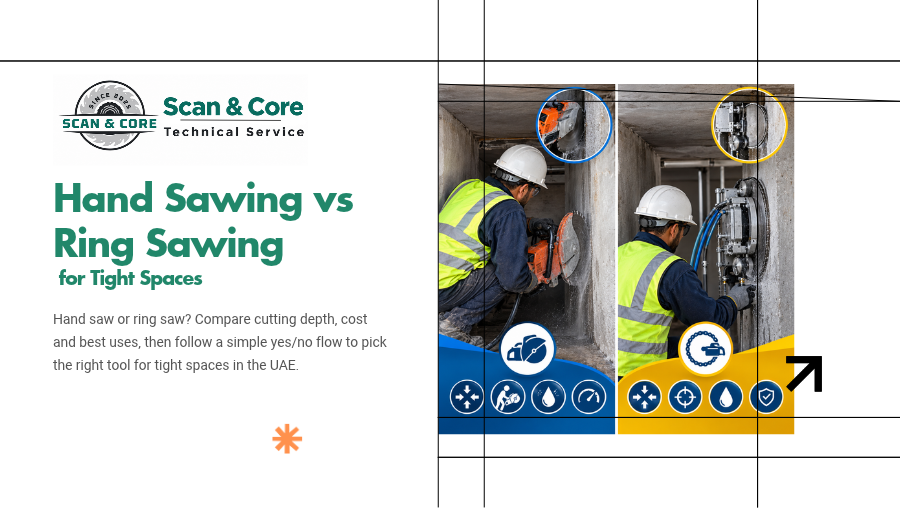
Not every concrete cut gets a big machine. Inside a villa bathroom, a riser cupboard, a plant room or a narrow corridor, there’s often no room to bolt on a wall saw track or wheel in a floor saw.
That’s where handheld saws take over. The two you’ll hear about most are the standard hand saw (a handheld power cutter) and the ring saw. They look similar, but they cut very differently.
Below, you’ll find a quick profile of each tool, then a simple yes/no flow to pick the right one for your job.
Tool profile: the hand saw
What it is: A handheld power cutter with a diamond blade fixed at its centre. The motor drives the blade through a central arbor, the same way a cut-off saw works.
Cutting depth: Limited by the hub. A traditional power cutter reaches roughly half the depth of a ring saw (Husqvarna), which in practice means around 100 to 150mm depending on blade size.
Best for:
- Shallow cuts in slabs, screeds and blockwork
- Chasing for small conduits
- Trimming edges and finishing corners
- Cutting from both sides of a thin wall
Watch out for:
- Overcuts at corners, because the round blade has to run past the corner to cut full depth
- Kickback if the blade binds in a deep cut
- Depth runs out quickly on structural walls
Tool profile: the ring saw
What it is: A handheld saw with a ring-shaped diamond blade driven from its outer edge, not its centre. With no hub in the middle, the blade can sink much deeper into the concrete.
Cutting depth: Up to 270mm with a 370mm ring, and 325mm with a 430mm ring, for one widely used model (Husqvarna). That’s enough to cut through a typical wall from one side.
Weight: Around 14kg for the same model, so it’s still a one-person tool.
Best for:
- Small and medium openings in walls up to around 300mm thick
- Cutting from one side when the other side is finished or inaccessible
- Jobs where there’s no space to fix a wall saw track
- Enlarging existing openings by a small amount
Watch out for:
- Higher blade cost per metre than a standard hand saw
- Still a circular cut, so corners need care
- Heavier and harder to control than a small cut-off saw
Side by side
| Hand saw | Ring saw | |
| Typical depth | About 100 to 150mm | About 270 to 325mm |
| Cuts thick walls from one side | No | Yes, up to around 300mm |
| Set-up time | Minimal | Minimal |
| Precision | Good | Good |
| Blade cost | Lower | Higher |
| Best job | Shallow cuts, chasing, trimming | Small openings in walls and slabs |
Which one? Answer these questions
1. Is the concrete deeper than about 150mm?
- No → a hand saw will usually do it.
- Yes → go to question 2.
2. Can you cut from both sides?
- Yes, and the element is under about 300mm → a hand saw cutting from both sides may work, but alignment has to be perfect. A ring saw from one side is often cleaner.
- No → go to question 3.
3. Is the element thicker than about 300mm?
- No → use a ring saw.
- Yes → a handheld tool isn’t enough. You need a wall saw or wire saw, even if space is tight. Modular wall saw kits fit through surprisingly small doorways.
4. Do you need sharp, square corners with no overcut?
- If yes, plan to core drill the corners first, or ask about a diamond chain saw. Chain saws cut up to around 390 to 450mm deep and can make openings as small as about 11 x 11cm, with square corners (Husqvarna).
Working in tight spaces safely
Small spaces make concrete cutting harder, whatever saw you use.
- Scan first. Tight spaces like risers and plant rooms are often packed with services. GPR concrete scanning shows what’s inside the wall or slab before the blade goes in.
- Check the fuel. Many handheld saws are petrol powered. In enclosed spaces that means exhaust fumes, so indoor jobs normally need electric or hydraulic versions, or strong ventilation.
- Cut wet. Water keeps silica dust down, which matters even more in small rooms.
- Contain slurry. In a finished bathroom or kitchen, protect floors, drains and the space below.
- Get approval for structural walls. If the wall is load-bearing, an engineer needs to approve the opening first. Start with a structural analysis.
Need a cut in a tight spot?
Scan and Core handles small-access concrete cutting across Dubai and Abu Dhabi, from villa bathrooms to tower risers. We scan first, pick the right tool for the space and leave the area clean.
Contact Scan and Core for a site visit, or call +971 56 861 9006.