Dubai isn’t slowing down. Dubai Municipality issued 10,776 building permits in the first quarter of 2026, up 12% on the same period last year, and carried out 10,855 on-site structural inspections in those three months (Gulf News).
Every one of those projects, new build or fit-out, eventually needs an opening, a penetration or a section of concrete removed. That’s where concrete cutting comes in.
This guide answers the questions we hear most from contractors, consultants and property owners across the city.
What is concrete cutting?
Concrete cutting is the controlled removal of concrete using diamond tools. Instead of breaking concrete with hammers or breakers, you cut it cleanly to an exact line, depth or diameter.
The result is a precise opening with smooth edges, very little vibration and far less risk of cracking the surrounding structure.
Which cutting method do you need?
The right method depends on what you’re cutting, where it is and how much space the crew has to work.
Wall sawing. A track-mounted diamond saw cuts vertical surfaces. Use it for door openings, window openings and lift shaft modifications in reinforced walls.
Flat (slab) sawing. A walk-behind saw cuts horizontal surfaces. Use it for floor trenches, expansion joints, and removing damaged slab sections in car parks or warehouses.
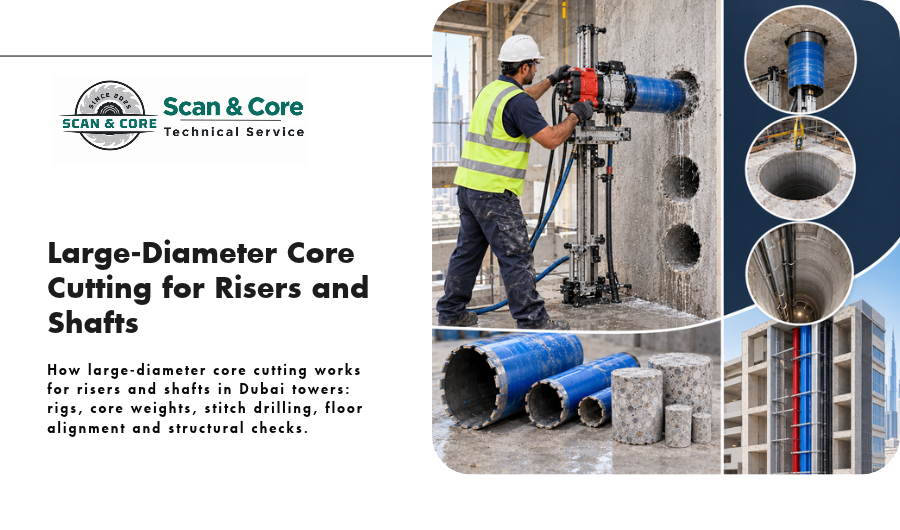
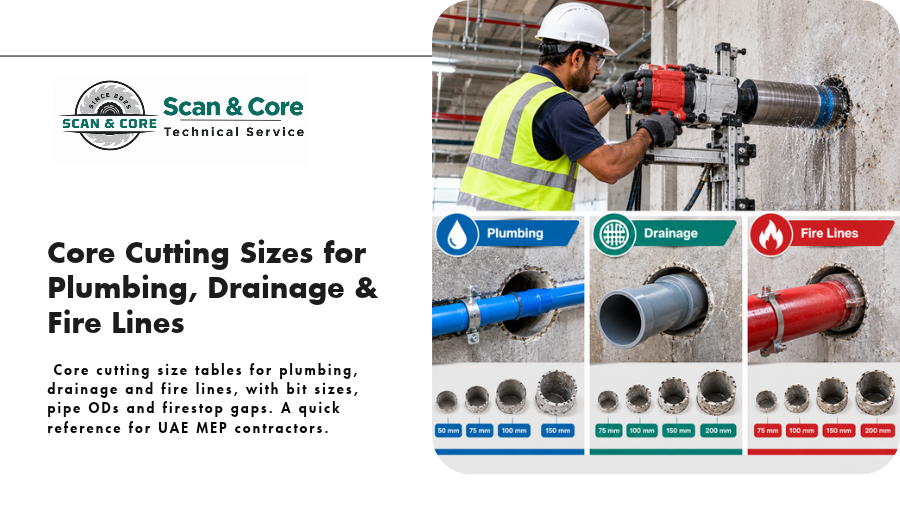
Core drilling. A rotating diamond bit cuts a perfect circle. Use it for MEP penetrations: pipes, cable routes, drainage and AC ducts. Diameters range from small anchor holes to large openings for piling and shafts.
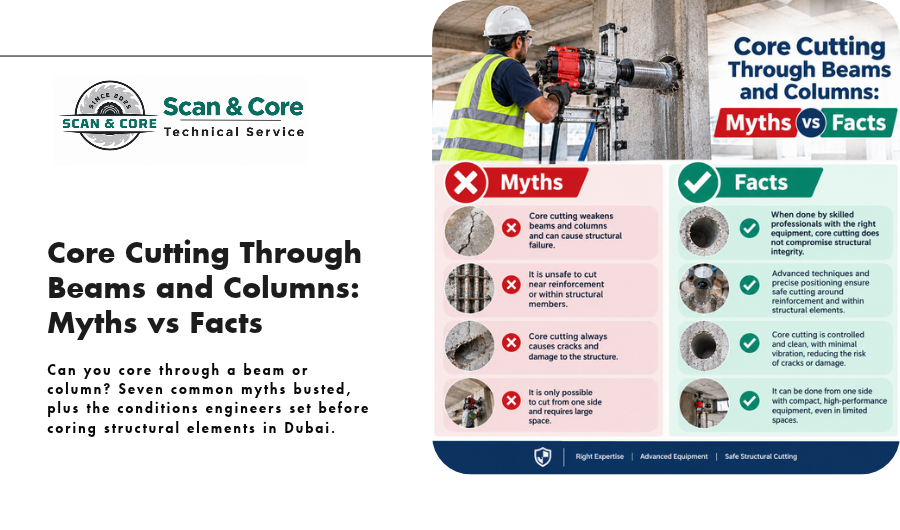
Wire sawing. A diamond wire loops around the section and cuts through it. Use it for very thick or oddly shaped elements, such as heavy foundations, columns and beams, where a blade can’t reach.
Hand sawing. A handheld diamond saw for small, tight or awkward cuts where larger machines won’t fit.
Not sure which one fits your job? Our concrete cutting works page covers each method in more detail.
When do Dubai projects need concrete cutting?
Most jobs fall into a few categories:
- Fit-outs and renovations. Adding doorways, relocating kitchens and bathrooms, or opening up floor plates in offices and villas.
- MEP installation. New pipework, electrical risers, fire-fighting lines and HVAC ducts all need clean penetrations.
- Structural modifications. New staircases, lift shafts, and openings in slabs or shear walls.
- Repairs. Cutting out deteriorated or damaged concrete before repair and strengthening work.
- Testing. Extracting core samples to check concrete strength in existing buildings. See our concrete testing services.
Why should you scan before you cut?
This is the step people skip, and it’s the one that causes the most expensive problems.
Dubai’s towers, podiums and car parks are full of reinforcement, embedded conduits and post-tension (PT) cables. You can’t see any of it from the surface. Cut through a rebar cluster and you may weaken the element. Cut through a live conduit and you risk injury and a building shutdown. Cut a PT tendon and you’re looking at a serious structural repair, plus possible injury from the stored tension releasing.
Ground penetrating radar (GPR) scanning maps what’s inside the concrete before a single blade touches it. The technician marks rebar, cables and services directly on the surface so the cutting crew can adjust the position of an opening or core by a few centimetres and avoid them.
If your slab is post-tensioned, scanning isn’t optional. Book concrete scanning works as part of the same job, not as an afterthought.
Do you need a permit or approval?
It depends on what you’re cutting and where.
- Small penetrations in non-structural areas usually just need building management or landlord approval, especially in occupied towers.
- Structural openings in slabs, beams, columns or shear walls typically need a structural engineer’s assessment and approval before work starts. Many also need an authority permit.
- Free zones and master developments can have their own approval route. Areas under Trakhees, Dubai Development Authority or a master developer often follow their own process rather than Dubai Municipality’s standard track.
If you’re changing the structure, get a structural analysis done first. It tells you whether the opening is safe as designed or needs strengthening, and it gives the approving body the documentation it expects. For help with paperwork, see our permits and approvals in Dubai service.
How much does concrete cutting cost in Dubai?
There’s no flat rate. Price comes down to a handful of factors:
- Thickness and depth. Deeper cuts take longer and wear through more diamond.
- Reinforcement density. Heavy rebar slows cutting.
- Method. Wire sawing and large-diameter coring cost more than standard slab sawing.
- Access. Overhead drilling, confined spaces and upper floors with no lift access add time.
- Working hours. Night or weekend work in occupied buildings costs more.
- Extras. Scanning, slurry containment, debris removal, lifting the cut block out and engineer sign-off.
As a rough guide, published 2026 UAE market rates put slab or wall sawing at around AED 220 to 420 per linear metre at 200mm depth, and a 150mm core at a few hundred dirhams per hole depending on depth and access. Structural openings are usually quoted as a fixed price per job.
Treat those numbers as a starting point only. The figure you can plan around comes from a site visit.
When is the best time to schedule the work?
If any part of your cutting job is outdoors, plan around the summer midday break. In 2026, outdoor work under direct sunlight was banned from 12:30pm to 3pm daily between 15 June and 15 September, and concrete cutting isn’t on the list of exempt activities (Khaleej Times).
For summer projects, that means early starts, shaded setups and realistic timelines. Indoor work in conditioned spaces isn’t affected in the same way.
In occupied buildings, your building management will usually set noisy work windows. Ask for them early so the crew schedule matches.
How do you control dust, noise and slurry?
Wet cutting is standard. Water cools the diamond blade and keeps silica dust down, which matters for anyone working nearby.
That water becomes slurry, and slurry can’t go into drains. A good crew brings containment, wet vacuums and a plan for disposal. In finished interiors, ask how they’ll protect flooring, fixtures and lifts before they start.
Diamond cutting is far quieter than breaking, but it isn’t silent. Expect some noise and plan around neighbours or tenants.
How do you choose a concrete cutting contractor in Dubai?
Ask these questions before you sign:
- Do you scan before cutting? If the answer is “only if you ask,” move on.
- What method will you use, and why? A good contractor explains the choice.
- Who handles slurry and debris? Get it in writing.
- Are your operators trained and insured?
- Can you coordinate with the structural engineer and the approving authority?
- Can you show similar work? Look at their past projects.
Choosing one team for scanning, cutting and structural assessment saves you from coordinating three companies and passing drawings back and forth.
Get your concrete cutting done right
Scan and Core handles concrete scanning, cutting, coring and structural assessment under one roof for projects across Dubai and Abu Dhabi. You get one point of contact, one schedule and a crew that scans before it cuts.
Contact Scan and Core for a site visit and quote, or call +971 56 861 9006.