Abu Dhabi is building fast. In the first half of 2026, the Department of Municipalities and Transport approved 43.6 million square metres of gross floor area, 40% more than the same period in 2025 (Abu Dhabi Media Office).
A lot of that work happens next to finished structures: towers being fitted out, villas being extended, car parks being upgraded. When you need to open up concrete in those settings, the method you choose matters as much as the opening itself.
That’s why diamond concrete cutting in Abu Dhabi has become the standard for work inside existing buildings. Here’s how it compares with traditional methods, and when each one makes sense.
The short answer
Traditional methods break concrete. Jackhammers, hydraulic breakers and chisels smash the material apart with repeated impact.
Diamond cutting grinds through it. A blade, core bit or wire set with industrial diamonds cuts a clean line through concrete and steel reinforcement, with water keeping the tool cool and the dust down.
One uses force. The other uses abrasion. That single difference drives almost everything else in this comparison.
How traditional concrete cutting works
“Traditional” usually means one of these:
- Pneumatic or electric jackhammers for small areas and surface removal.
- Hydraulic breakers mounted on excavators or mini machines for bulk demolition.
- Abrasive blades (silicon carbide rather than diamond) on cut-off saws, which wear fast on reinforced concrete.
- Stitch drilling and breaking, where a line of percussion holes is drilled and the concrete between them is knocked out.
These tools are simple and widely available. They’re fine when the goal is to remove concrete and you don’t care much about what’s left behind.
How diamond cutting works
Diamond tools have segments of synthetic diamond bonded to a steel blade, bit or wire. As the tool turns, the diamonds grind away concrete and rebar in one pass.
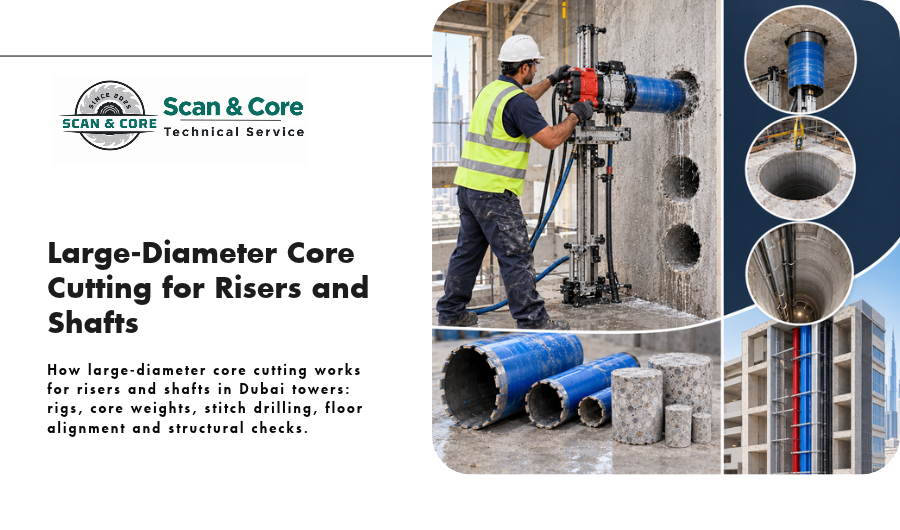
The main diamond methods are wall sawing, slab sawing, core drilling and wire sawing. You’ll find each one explained on our concrete cutting works page, so here we’ll focus on how the approach as a whole stacks up.
Head-to-head comparison
| Factor | Diamond cutting | Traditional breaking |
| How it removes concrete | Grinds a clean cut line | Impact shatters the material |
| Edge finish | Smooth, straight, ready for frames or sleeves | Rough, irregular, needs making good |
| Accuracy | To the millimetre | Approximate |
| Vibration | Very low | High |
| Risk to surrounding structure | Low | Micro-cracking and spalling are common |
| Noise | Moderate, steady | Loud, percussive |
| Dust | Low (wet cutting) | High |
| Cutting through rebar | Cuts steel and concrete together | Rebar has to be cut separately |
| Thick sections | Wire saw handles very thick elements | Slow and labour heavy |
| Equipment cost | Higher | Lower |
| Total job cost | Often lower once repairs are counted | Often higher once repairs are counted |
The six differences that matter most
1. What happens to the concrete you keep
This is the big one. Every hammer blow sends shock through the element. In a slab or wall you’re keeping, that can open hairline cracks, loosen the bond between concrete and rebar, and cause spalling around the opening.
You may not see the damage straight away. It shows up later as cracking, water ingress or corrosion, and then it needs repair and strengthening.
Diamond cutting doesn’t hammer the structure. The concrete on the other side of the cut line stays intact.
2. Precision and finish
A diamond-cut opening comes out square, straight and to size. Door frames, window systems and pipe sleeves fit without extra work.
A broken opening is rough and oversized in places. Someone has to trim it, patch it and plaster it before the next trade can start. That’s extra time and extra cost, even if it doesn’t appear in the cutting quote.
3. Working in occupied buildings
If you’re cutting in an occupied tower on Al Reem Island or a working office in the city centre, vibration and impact noise travel through the whole frame. Tenants three floors away will hear a breaker.
Diamond cutting is quieter and nearly vibration-free, so building management is far more likely to approve it during normal hours.
4. Dust and site health
Breaking dry concrete throws respirable silica dust into the air. That’s a serious health risk for workers and anyone nearby, and it gets everywhere in a finished interior.
Diamond cutting is normally done wet. The water captures dust at the source and turns it into slurry, which a good crew contains and removes.
5. Speed on reinforced concrete
Traditional breaking slows right down when it hits rebar. The steel has to be exposed and then cut with a separate tool.
A diamond blade or wire cuts concrete and steel in one pass. On heavily reinforced elements, which describes most structures in the UAE, that’s a major time saving.
6. True cost
Diamond cutting usually costs more per linear metre than a crew with breakers. But the comparison changes once you add in:
- making good rough edges
- repairing cracks caused by vibration
- cleaning dust out of finished areas
- delays from building management restricting noisy work
For most openings in structures you’re keeping, diamond cutting ends up the cheaper option overall.
When traditional methods still make sense
Diamond cutting isn’t always the right answer. Breakers are still the practical choice when:
- The whole structure is coming down. If nothing is being kept, there’s no need to protect it.
- You’re removing large volumes of mass concrete at ground level with no finished surfaces nearby.
- You’re breaking out concrete that’s already been cut. A common approach is to diamond-cut the perimeter first, then break up the section inside it for easier removal.
That last point is worth noting. The two methods often work together, with diamond cutting setting a clean boundary so the breaking can’t spread past it.
One rule applies to both: scan first
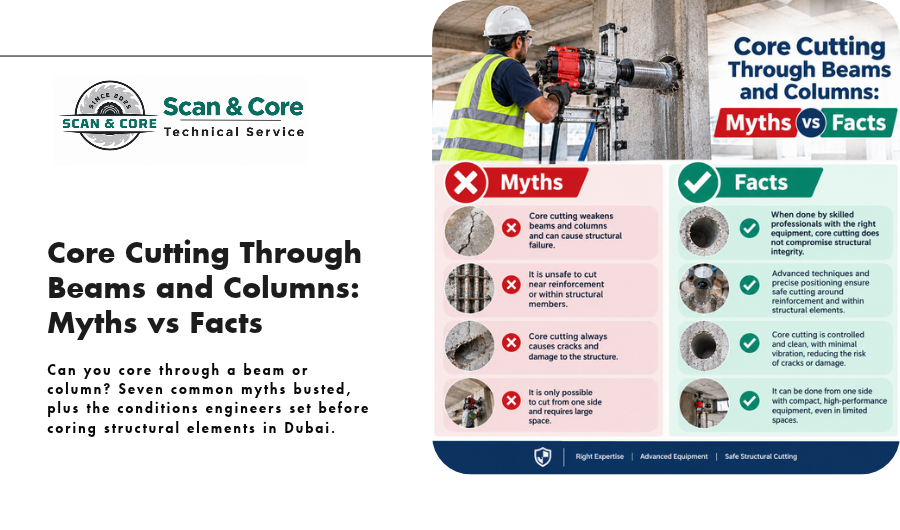
Whichever method you use, you need to know what’s inside the concrete before you start. Post-tension cables, embedded conduits and dense rebar are invisible from the surface.
Ground penetrating radar concrete scanning maps them in advance so the opening can be positioned safely. For structural openings, pair the scan with a structural analysis so you know the element can take the change.
Which should you choose?
Ask yourself one question: are you keeping the structure around the cut?
If yes, choose diamond cutting. You’ll get a cleaner result, less damage, fewer complaints and, in most cases, a lower final bill.
If the whole element is being demolished and nothing nearby needs protecting, traditional breaking may be enough.