Renting a cut-off saw or a small core drill is easy. Knowing whether you should be the one using it is harder.
The stakes are real. Since the start of 2026, Dubai Municipality has carried out more than 16,000 inspections in residential areas and recorded 2,395 breaches linked to building use, occupancy and unauthorised construction. The municipality also made clear that everyday jobs like adding a kitchen window, removing a non-structural wall or opening up a closed kitchen fall under its rules (The National).
Use the checklist below. If you tick even one box, you need professional concrete cutting services, not a hire-shop saw.
The 10-point checklist
☐ 1. The element holds something up
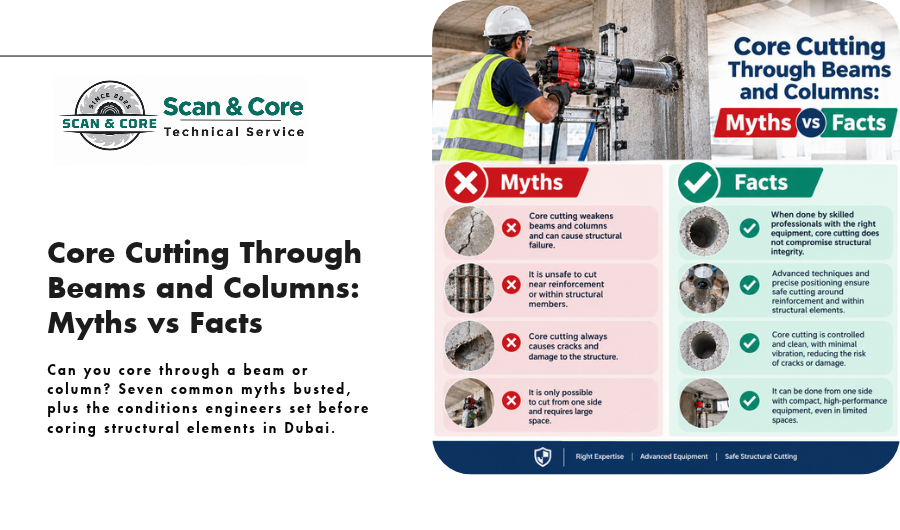
Slabs, beams, columns, shear walls and load-bearing walls are structural. Cutting them changes how loads travel through the building.
An opening in the wrong place, or one that’s too large, can overload the concrete around it. You need an engineer to check the design first and a crew that can cut exactly to the approved size. Start with a structural analysis.
☐ 2. You’re in a tower, podium or modern car park
Many multi-storey buildings in Dubai and Abu Dhabi use post-tensioned (PT) slabs. The steel tendons inside are under huge tension. Cut one and it can snap out of the slab, injure people nearby and leave you with a major structural repair.
If there’s any chance the slab is post-tensioned, stop. It needs GPR concrete scanning before anyone drills.
☐ 3. You don’t know what’s inside the concrete
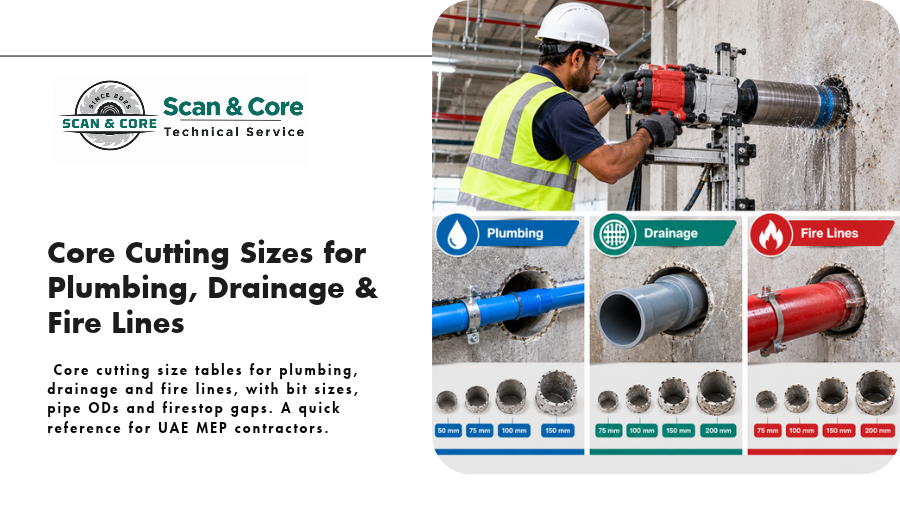
Even in a villa, walls and floors carry rebar, electrical conduits, water lines and drainage. None of it is visible from the surface, and old drawings are often wrong or missing.
A professional crew scans and marks everything before cutting. A DIY job finds out the hard way.
☐ 4. The concrete is thicker than about 100mm
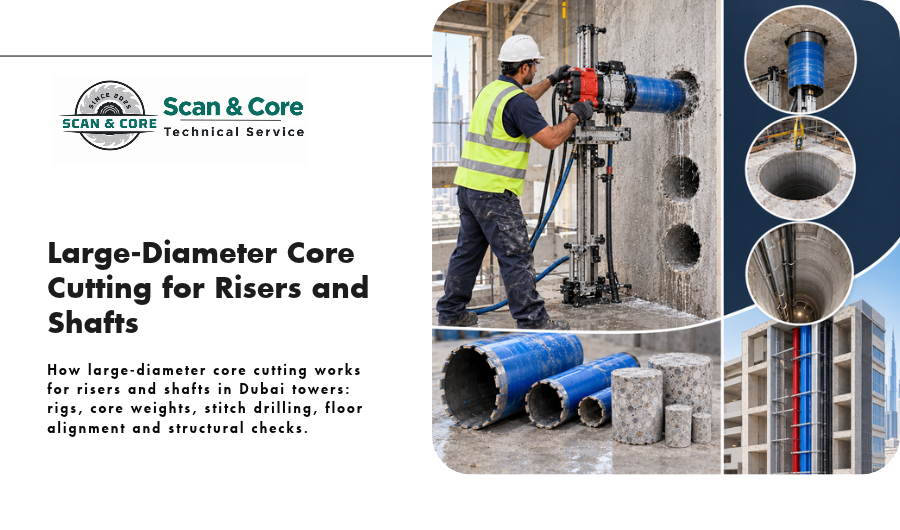
Handheld saws have limited depth. Past that point you need wall saws, slab saws or wire saws, plus the experience to set them up safely. Forcing a small tool deeper leads to binding, kickback and burnt-out blades.
☐ 5. You need a clean, exact opening
Door frames, window systems, lift shafts and pipe sleeves need openings cut to size and square. Professional concrete cutting delivers edges that are ready for the next trade. Rough cuts mean trimming, patching and delays.
☐ 6. The work needs a permit or NOC
Structural changes, new openings and layout modifications usually need authority approval. In Dubai that could be Dubai Municipality, Trakhees or the Dubai Development Authority depending on location. In Abu Dhabi it’s the Department of Municipalities and Transport. Your building or community management will also want an NOC.
Approving bodies expect licensed contractors and proper documentation. If you need help with the paperwork, see our permits and approvals service.
☐ 7. The building is occupied
Tenants, offices, retail units and hotel guests don’t want noise, vibration, dust or water leaking through the ceiling. Building management usually restricts working hours and asks for method statements and insurance.
Professionals bring slurry containment, floor protection and a plan that building managers will sign off.
☐ 8. You’re cutting overhead or in a tight space
Drilling into a soffit or cutting inside a riser or plant room adds real risk. Water, slurry and heavy cut sections all come down. Specialist rigs and anchoring are needed to do it safely.
☐ 9. A heavy section has to come out
A 200mm reinforced concrete block the size of a doorway can weigh well over half a tonne. Removing it needs planning: supports, lifting gear and a route out of the building.
☐ 10. The concrete is damaged or you need test samples
Cracked, spalled or corroded concrete needs careful removal before repair and strengthening. And if you need cores for strength testing, they must be taken to the right size and handled correctly for lab results to count. See our concrete testing services.
When a DIY tool might be enough
To be fair, not every job needs a specialist. You might manage on your own if all of these are true:
- It’s a small, shallow cut in a garden path, paver or non-structural screed.
- Nothing is buried underneath, and you’ve checked.
- No permit or NOC is involved.
- Nobody else is nearby, and you have proper PPE, water suppression and experience with the tool.
If you hesitated on any of those, call a professional.
What does it cost to get it wrong?
Skipping professional help usually costs more in the end. The typical bills include:
- Structural repair after cutting through rebar or a PT tendon.
- Utility repair after hitting a conduit or water line, plus downtime for the building.
- Fines and stop-work orders for unapproved modifications.
- Rectification work if the authority orders the opening closed or rebuilt.
- Making good rough, oversized openings before finishes can go on.
- Injury to you or someone else.
A site visit and a quote cost nothing. A bad cut can cost a lot.
How the professional process works
A proper job follows a clear order:
- Site visit to check the element, access and building rules.
- Scanning to map rebar, PT cables and services.
- Engineering check for structural openings.
- Approvals from the authority and building management.
- Cutting with the right method, water suppression and containment.
- Removal and clean-up of cut sections and slurry.
Ticked a box? Talk to Scan and Core
Scan and Core handles scanning, structural checks and diamond cutting for homes, towers and commercial sites across Dubai and Abu Dhabi. One team, one schedule, and every cut is scanned first.
Contact Scan and Core to book a site visit, or call +971 56 861 9006.