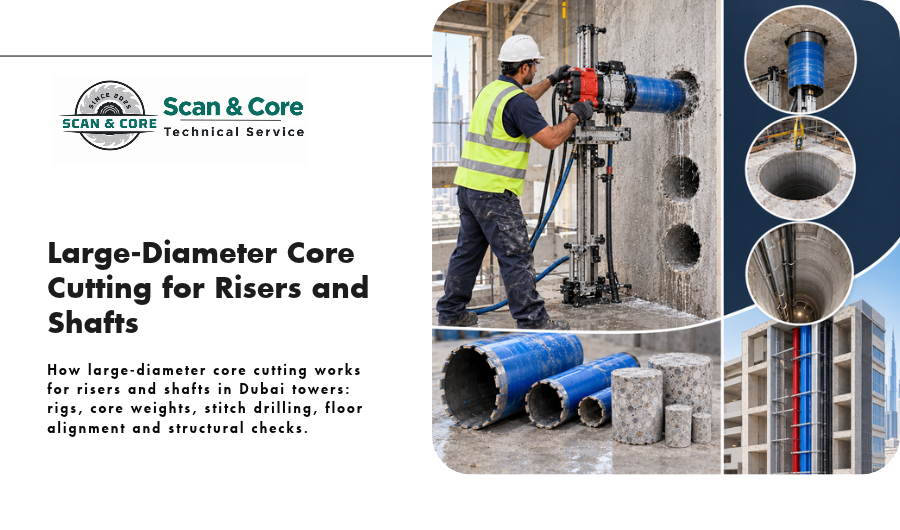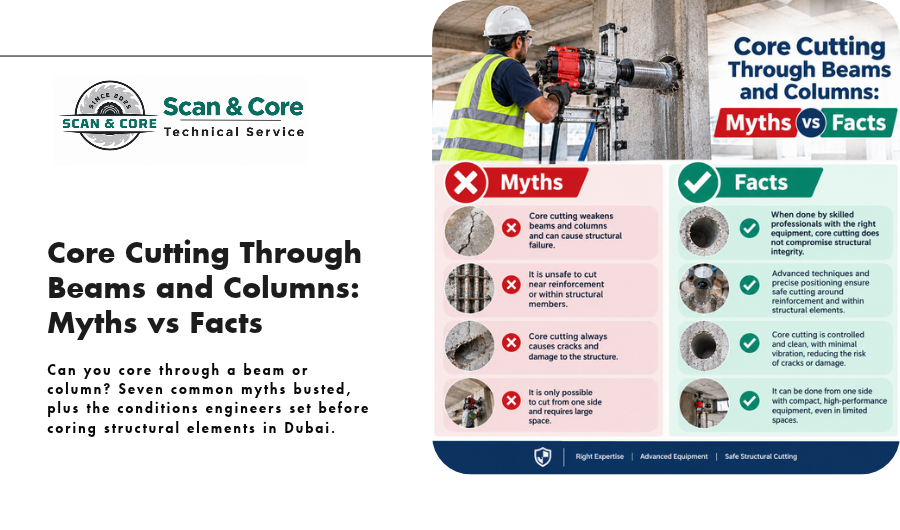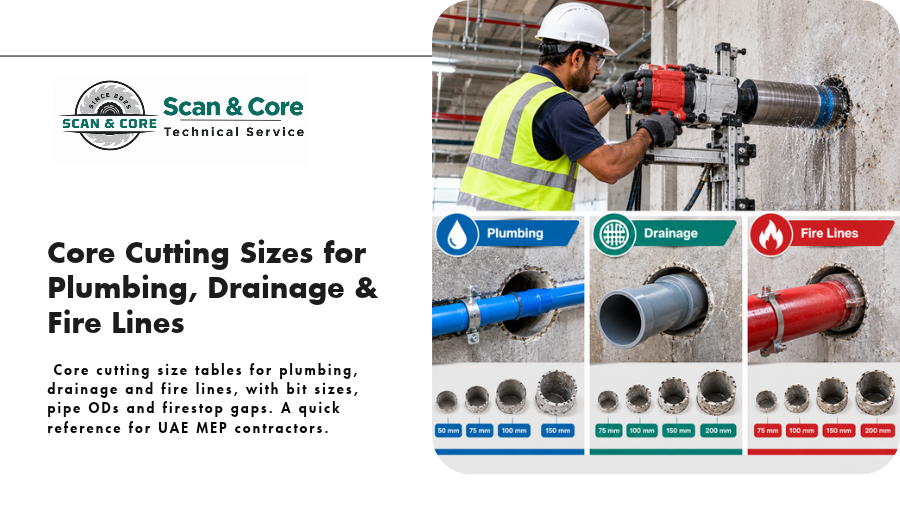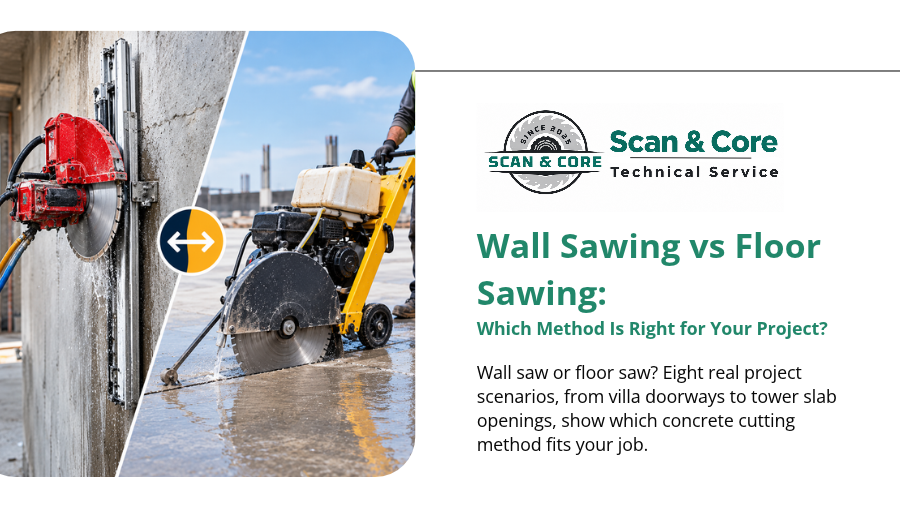
The names suggest an easy rule: wall saws for walls, floor saws for floors. In practice, it’s not that simple.
A wall saw often cuts slabs. A floor saw can’t cut a wall at all. And sometimes the right answer is a mix of both, plus a core drill at each corner.
This guide skips the theory and works through real project scenarios so you can see which method fits yours.
The two methods in 60 seconds
Wall sawing uses a diamond blade mounted on a track that’s bolted to the concrete. The saw head runs along the track and cuts to a precise line. Because the track can be fixed to almost any surface, a wall saw cuts vertical walls, horizontal slabs, inclined surfaces and even overhead. Large hydraulic wall saws can cut reinforced concrete up to 730mm thick (Husqvarna).
Floor sawing (also called flat or slab sawing) uses a walk-behind machine with a diamond blade underneath. The operator pushes or drives it across a flat horizontal surface. It only cuts from above, on floors, slabs, roads and pavements. Mid-size models cut roughly 310 to 410mm deep, and the largest can reach about 620mm with a 1,500mm blade (Husqvarna).
The short rule: floor saws are fast on long, straight, horizontal cuts with open space around them. Wall saws are precise, portable and work in any direction.
Match your project to the method
Scenario 1: New doorway in a villa wall
Use: wall saw
This is what wall saws were built for. The track goes on the wall, the saw cuts the four sides of the opening, and the block comes out in one piece or a few sections. The edges are clean enough for a door frame to go straight in.
A floor saw has no way to cut a vertical surface, so it isn’t an option here.
Scenario 2: Drainage trench across a warehouse slab
Use: floor saw
Long, straight parallel cuts on a ground-bearing slab with plenty of space are where floor saws win. They move quickly, cut continuously and keep the depth consistent over tens of metres. The concrete between the cuts is then broken out and removed.
A wall saw could do it, but you’d spend far more time moving and re-fixing the track.
Scenario 3: Stair or shaft opening in a suspended slab
Use: wall saw (in most cases)
This surprises people. On an upper floor, a wall saw is usually the better choice even though you’re cutting a floor. The track bolts to the slab and the saw cuts a precise rectangle.
Why not a floor saw? Large floor saws are heavy. The biggest self-propelled models weigh over a tonne, which is a lot to put on a suspended slab and often impossible to get up there anyway. Wall saws break down into modules light enough to carry.
Before any opening in a suspended slab, get a structural analysis done. The slab may need temporary propping and permanent strengthening around the new opening.
Scenario 4: Removing a damaged section of car park slab
Use: floor saw
For ground-level or basement slabs with good access, a floor saw cuts the damaged area into manageable panels quickly. Those panels are lifted or broken out, and the area is prepared for repair and strengthening.
For damage on an upper car park deck, see Scenario 3 and think wall saw.
Scenario 5: Cutting tight against a wall or column
Use: wall saw
Floor saws can’t cut right up to a wall. The blade guard and machine body get in the way, leaving a strip that has to be finished by hand.
Wall saws can be fitted for flush cutting, which lets the blade run tight against an adjacent surface. If you need an opening that finishes flush with a wall or column face, this is the method.
Scenario 6: Cutting on the 30th floor of an occupied tower
Use: wall saw
Access decides this one. Wall saw components are carried in through service lifts and corridors. A walk-behind floor saw often won’t fit, and building management won’t want diesel machinery running indoors. Electric floor saws exist, but they’re still bulky.
A compact track setup also takes up less corridor space and is easier to screen off, which matters when tenants are working nearby.
Scenario 7: Road, pavement or external hardstanding
Use: floor saw
Utility crossings, road repairs and cuts in external paving are floor saw territory. The machines are designed for outdoor work over long runs, and they’re far quicker than any track-mounted method.
Scenario 8: Opening in a thick core or retaining wall
Use: wall saw, or wire saw if it’s too thick
For walls up to around 700mm, a large hydraulic wall saw can handle it. Beyond that, or for unusually shaped elements, wire sawing takes over. A diamond wire can cut through sections far thicker than any blade can reach.
Four questions that decide it
If your project doesn’t fit a scenario above, answer these:
- Is the cut vertical, inclined or overhead? Wall saw. Only flat horizontal cuts can use a floor saw.
- Is there space and access for a heavy machine? If not, wall saw.
- Is it a long, straight run on a ground-bearing surface? Floor saw will be faster and usually cheaper.
- Do you need flush edges or millimetre accuracy? Wall saw.
A note on corners
Circular blades can’t cut a perfectly square inside corner. Stopping the cut short leaves concrete attached, and running it past the corner leaves an overcut into the concrete you’re keeping.
Professional crews solve this by core drilling each corner first, then saw cutting between the holes. It’s a small detail that makes a real difference to the finished opening, especially in structural elements where overcuts aren’t acceptable.
What both methods need
Whichever saw you use, three things don’t change:
- Scan first. Map rebar, post-tension cables and embedded services with GPR concrete scanning before cutting.
- Cut wet. Water cools the blade and controls silica dust.
- Contain the slurry. It can’t go into drains, and it stains finishes.
Not sure which saw you need?
You don’t have to decide alone. Scan and Core runs both wall saws and floor saws across Dubai and Abu Dhabi, and we’ll recommend the method after seeing the site, not before. Find out more about our concrete cutting works.
Contact Scan and Core for a site visit, or call +971 56 861 9006.