Every core cutting job starts with the same choice: hold the drill by hand, or mount it on a rig. The answer affects how big the hole can be, how straight it runs, how long it takes and how safe the job is.
Here’s how the two machines compare, and which one suits common jobs on UAE sites.
What each machine is
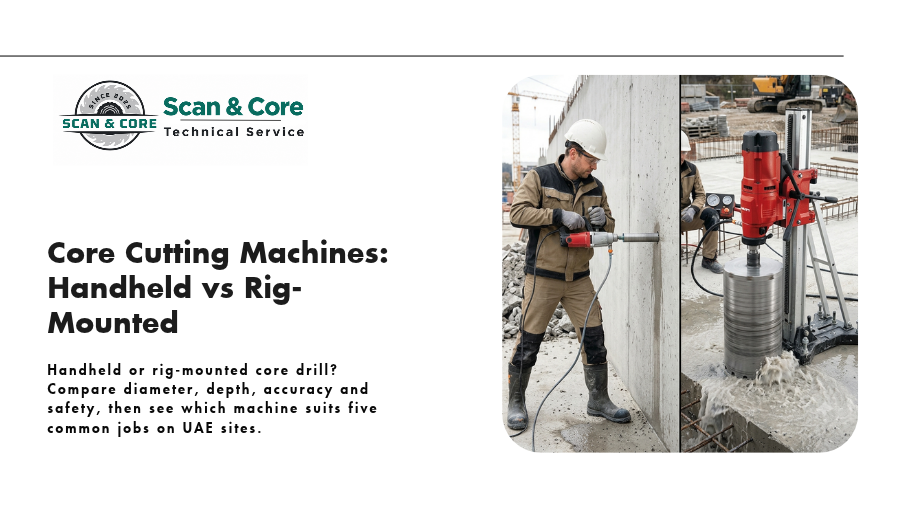
Handheld core drill. A compact motor with a handle, held and guided by the operator. Some have a small water feed or a dust extraction port. Think of it as a heavy-duty drill built for core bits.
Rig-mounted core drill. A more powerful motor mounted on a stand. The stand has a base fixed to the concrete, a vertical column, and a carriage that the motor slides down as it drills. The operator turns a handle to feed the bit into the concrete at a steady rate.
Head-to-head
| Handheld | Rig-mounted | |
| Typical diameter | Small holes, roughly up to 150mm, smaller in heavily reinforced concrete | Small to very large, from about 50mm up to several hundred millimetres |
| Depth | Shallow to moderate | Deep cores and thick slabs |
| Straightness | Depends on the operator | Accurate and square to the surface |
| Angled holes | Hard to control | Rig can be set to a precise angle |
| Set-up time | Very quick | Longer, as the base must be fixed |
| Weight | Light, one person | Heavier, often carried in parts |
| Reinforced concrete | Limited | Built for it |
| Operator fatigue | High on long jobs | Low, as the rig takes the load |
| Control if the bit binds | Operator absorbs the torque | Rig absorbs it |
How rigs are fixed
The base of a rig is held in place in one of two ways:
- Anchor fixing. A single anchor bolt is set into the concrete and the base is clamped down. It’s very secure and works on walls, slabs and ceilings.
- Vacuum fixing. A rubber seal and vacuum pump hold the base to the surface. There’s no anchor hole, which makes it useful on finished floors, but it needs a smooth, sound surface.
For overhead and large-diameter work, anchor fixing is the safer choice.
Where handheld drills win
- Small holes for AC drains, cables and small pipes
- Blockwork and brick walls
- Tight spaces where a rig won’t fit
- Quick one-off holes where set-up time matters more than speed
Where rig-mounted drills win
- Reinforced concrete slabs and walls
- Anything over about 150mm in diameter
- Deep cores through thick slabs, beams (with approval) and walls
- Holes that must be straight, square or at an exact angle
- Overhead drilling
- Long runs of cores where consistency matters
Five jobs, five picks
1. A 52mm hole through a villa blockwork wall for an AC drain. Handheld. It’s quick, light and accurate enough.
2. A 152mm hole through a 250mm reinforced slab for a soil pipe. Rig-mounted. Reinforcement, depth and the need for a vertical hole all point to a rig.
3. Twenty cores for a sprinkler upgrade in an Abu Dhabi office. Rig-mounted. Consistent, straight holes, less fatigue and faster overall.
4. A small cable hole inside a cramped riser cupboard. Handheld, if the hole is small and there’s no heavy reinforcement. Otherwise a compact rig.
5. A 400mm core for a kitchen extract shaft. Rig-mounted, anchored, with a plan for supporting and lifting the core.
Safety differences
Handheld drills put the twisting force straight into the operator’s wrists and shoulders if the bit catches on steel. Good machines have a slip clutch to reduce this, but it’s still the biggest risk with handheld work.
Rigs take that force into the concrete through the base, so the operator stays in control. That’s why rigs are the standard for reinforced concrete.
Whichever machine is used, the location should be checked with GPR concrete scanning first.
Get the right machine for your job
Scan and Core runs handheld and rig-mounted core cutting across Abu Dhabi and Dubai, matched to the hole, the material and the space. See our concrete cutting and coring services.
Contact Scan and Core for a site visit, or call +971 56 861 9006.