The scanning is done. The concrete is covered in paint marks and tape, and a PDF lands in your inbox. Now what?
A GPR scan report is only useful if the people drilling, cutting and signing off the work read it properly. Here are the questions we hear most, answered plainly.
What should a GPR scan report include?
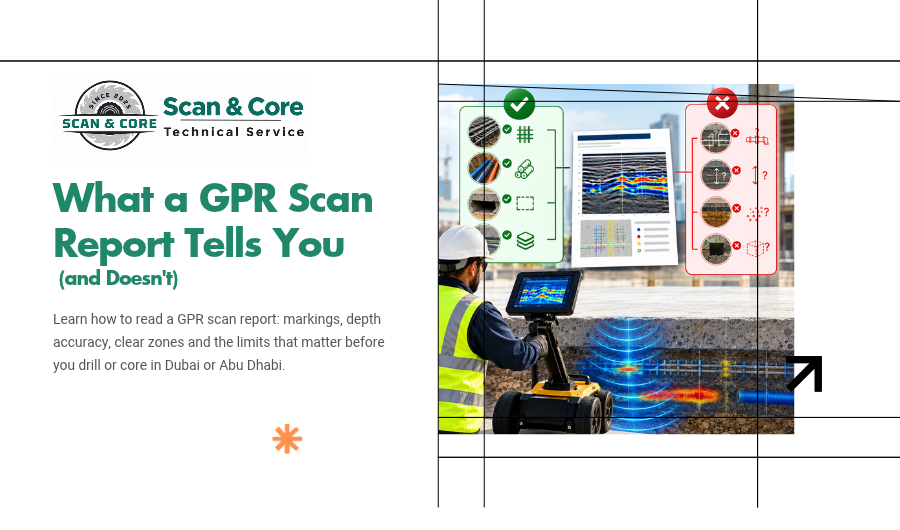
A complete report usually covers:
- Project details: site, building, floor, date and who carried out the scan.
- Scan locations: where each area was scanned, ideally on a drawing or photo with gridlines.
- Equipment and settings: the scanner used, antenna frequency and depth range.
- Method: line scans, grid scans, directions scanned and how depth was calibrated.
- Findings: what was detected in each area, with depths and spacing.
- Images: radar profiles or 3D slices showing the targets.
- Site photos: the markings on the concrete, so anyone can match the report to the surface.
- Limitations: anything that affected the scan or couldn’t be checked.
- Recommendations: safe drilling zones, areas to avoid and any follow-up needed.
If your report is a single page with a few photos and no limitations section, ask for more.
What do the colours on the concrete mean?
There isn’t one universal colour code for scan markings. Many teams use different colours for rebar, post-tension cables and electrical or other services, and some mark clear zones for drilling separately.
The rule is simple: the report must include a legend, and the crew must read it. Never assume red means the same thing on every site.
How accurate are the depths?
Depth accuracy depends on calibration. Radar travels at different speeds through different concrete mixes, so the technician needs to calibrate on site. That might mean matching the scan to a known depth, such as an existing core hole or the slab edge, or using the shape of the radar reflections to estimate signal speed.
A good report says how depth was calibrated and gives a realistic tolerance. Treat depths as close estimates, not exact measurements, and build that margin into your drilling depth.
Does the report tell me whether something is rebar, a PT cable or a conduit?
It tells you what the technician believes each target is, based on its depth, spacing, pattern and signal strength. For example, evenly spaced targets at a steady depth usually mean rebar. A single target that rises and falls across a slab is typical of a post-tension tendon.
These are expert interpretations, not certainties. A good report says when a target couldn’t be identified with confidence and marks it as something to avoid.
What’s a “clear zone”?
It’s an area where the scan found no targets within the scanned depth. Clear zones are where drilling or coring is safest.
Two cautions. First, “clear” only applies to the depth that was scanned. Second, it only applies to the exact area that was scanned. Moving a core 300mm to the left puts it outside the scan.
What the report doesn’t tell you
This is where problems start. People read a clean report and assume more than it covers.
Does it tell me whether a conduit is live?
No. GPR detects that an object is there. It can’t tell whether a cable is carrying power. Treat every conduit as live until the building’s electrical team confirms otherwise.
Does it cover what’s below the maximum scan depth?
No. Anything deeper than the scanner’s range isn’t covered. If your core will go through a thick slab or transfer beam, check the report’s stated depth range against your full drilling depth.
What about slabs on metal decking?
GPR can’t see through the steel deck. A report on a composite slab will show the deck, but not what’s hanging under it. You’ll need to check the underside separately.
Does it confirm the concrete is structurally sound?
No. A scan maps what’s inside the concrete. It doesn’t assess strength, cracking or whether the element can take a new opening. That’s a job for structural analysis and, if needed, concrete testing.
Does it give permission to drill?
No. The report is information. Approval to drill or cut comes from the structural engineer, the consultant and building management.
How long is a scan report valid?
A report is valid for the exact locations scanned, as long as the markings are still there and nothing has changed. Paint gets cleaned off, tape gets pulled up, and drilling positions move. If the marks are gone or the location has shifted, scan again. It costs far less than a strike.
Who should read the report?
Everyone involved in the drilling decision:
- The drilling or cutting crew, before they start.
- The site engineer or supervisor, to check locations that match the drawings.
- The structural engineer, especially for PT slabs and structural openings.
- Building or facility management, for their records and approvals.
What are the warning signs of a weak report?
- No limitations section.
- No mention of how depth was calibrated.
- No legend for the markings.
- No drawing or photo tying findings to real locations.
- Every target labelled with total certainty.
- No recommendation for areas that were hard to read.
What should I do if the report shows a problem?
If your planned core or cut clashes with a PT cable, a live service or dense reinforcement, don’t drill. Speak to the engineer about moving the location. Often a shift of a few centimetres solves it. If the location can’t move, the engineer will advise on the next step.
Get a report you can actually use
Scan and Core provides GPR concrete scanning across Dubai and Abu Dhabi, with clear on-surface marking and a written report that states what was found, how it was measured and what it doesn’t cover. If you need cutting or coring afterwards, we can do it in the same visit.
Contact Scan and Core to book a scan, or call +971 56 861 9006.