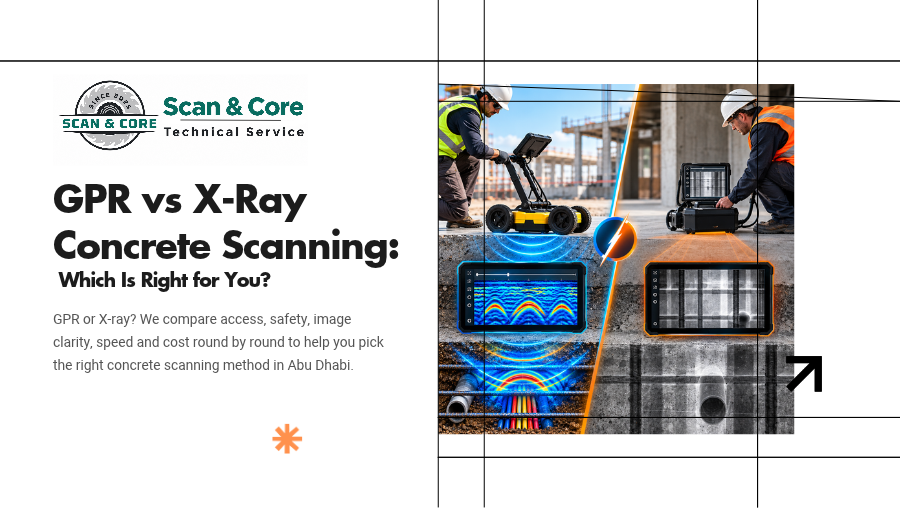
You need to drill or cut into a slab and you want to know what’s inside first. Two technologies can show you: ground penetrating radar (GPR) and X-ray imaging, also called concrete radiography.
Both work. They just suit different jobs. This post puts them through eight rounds, one factor at a time, so you can see which fits your project in Abu Dhabi or anywhere else in the UAE.
If you’re new to GPR, start with our explainer on how GPR concrete scanning works.
The quick version
GPR sends radar pulses into the concrete from one side and reads the echoes. It’s fast, portable and radiation-free.
X-ray passes radiation through the concrete onto a film or digital plate on the other side. It produces a photo-like image of everything in its path.
Now the rounds.
Round 1: Access
GPR: Needs one side only. You scan the top of a slab or the face of a wall and that’s it.
X-ray: Needs both sides. The source goes on one face and the imaging plate on the other. For a suspended slab, that means access to the floor above and the ceiling below.
Winner: GPR. Slabs on grade, retaining walls, and any element with one face buried or blocked rule out X-ray straight away.
Round 2: Safety and site disruption
GPR: Uses low-power radio energy. Nobody has to leave the area. The team can scan while other trades keep working nearby.
X-ray: Uses ionising radiation, so the area around the shot has to be cleared and controlled. In the UAE, industrial radiography is licensed and regulated by the Federal Authority for Nuclear Regulation (FANR), whose guidance covers exclusion distances, worker dose limits and qualified radiographers (FANR). In occupied buildings, that often means working at night or on weekends and clearing floors above and below.
Winner: GPR. In a working office tower on Al Maryah Island or a hospital in the city, clearing zones is often not practical.
Round 3: Image clarity
GPR: Produces a radar profile made of curved reflections. A trained technician reads it and marks targets on the surface. It’s highly reliable, but it’s an interpretation rather than a picture.
X-ray: Produces a clear, photo-like image. Rebar, cables, conduits and even the strands inside a tendon show up in sharp detail, and overlapping objects can be told apart.
Winner: X-ray. When you need to see exactly what’s there, especially in a congested area, nothing beats a radiograph.
Round 4: Depth and thickness
GPR: A typical handheld concrete unit scans up to around 500 to 600mm deep. Dense reinforcement near the surface can shadow targets below it.
X-ray: Works through the full thickness because it’s imaging all the way through, but thicker sections need stronger sources and longer exposures. Portable setups are most practical on slabs and walls of moderate thickness.
Winner: Draw. Both handle typical building elements. For very thick or heavily congested sections, ask your specialist which will give usable results.
Round 5: Speed
GPR: Results appear on screen as you scan. A technician can cover a large area and mark it up the same visit, and cutting can often start right after.
X-ray: Each shot covers a limited area and needs setup, exclusion, exposure and processing. Several locations can take a full shift or more.
Winner: GPR. On a tight programme, real-time results make a big difference.
Round 6: Area coverage
GPR: Built for coverage. Scan a whole floor plate, a long wall or a series of core locations in one visit.
X-ray: Built for spot checks. Each image covers a small panel, so large areas get expensive fast.
Winner: GPR.
Round 7: Cost
GPR: Lower cost per location and per square metre. Minimal setup, no exclusion zone, no out-of-hours premium in most cases.
X-ray: Higher cost per shot, plus the knock-on costs of clearing areas, night work and licensed radiographers.
Winner: GPR for most jobs. X-ray earns its cost on critical locations where you need certainty.
Round 8: What each one can tell you
GPR: Locates rebar, post-tension cables, conduits (metal and plastic), voids and slab thickness. It measures cover depth well.
X-ray: Shows the same targets in more detail and can reveal things GPR might struggle with, such as a conduit sitting directly under a bar, or the exact layout inside a congested beam-column joint.
Winner: X-ray. GPR still handles everyday locating very well, but for the hardest questions, X-ray shows more.
Final score
GPR 5, X-ray 2, one draw.
GPR wins on practicality. X-ray wins on detail.
Choose GPR when
- You only have access to one side.
- The building is occupied and can’t be cleared.
- You need to scan a large area or many core locations.
- You want results the same day and cutting to follow straight after.
- Budget matters.
For most drilling, coring and cutting jobs in Abu Dhabi and Dubai, GPR is the right tool.
Choose X-ray when
- You have access to both sides and can clear the area.
- The location is congested and a mistake would be critical.
- An engineer needs an exact picture, not an interpreted one.
- GPR results are unclear, for example because of dense reinforcement shadowing deeper targets.
Or use both
On high-risk jobs, the two work well together. GPR scans the wider area quickly and flags any location that’s hard to read. X-ray is then used only on those few spots. You get full coverage at GPR cost, with X-ray certainty where it counts.
Talk to Scan and Core
Scan and Core provides GPR concrete scanning across Abu Dhabi and Dubai, with on-surface marking and a written report for every job. If your project needs a deeper look, we’ll tell you whether it’s worth adding another method before you start cutting or coring.
Contact Scan and Core to discuss your project, or call +971 56 861 9006.