Some concrete is simply too big for a blade. A raft foundation more than a metre deep, a transfer beam, a massive column or a pile that needs cropping are all beyond the reach of wall saws and floor saws.
That’s where wire sawing comes in. It can cut through concrete of almost any thickness and shape, cleanly and with very little vibration.
There’s no shortage of heavy concrete in Dubai. In the first quarter of 2026 alone, 824,381 cubic metres of concrete were supplied to active sites across the emirate (Gulf News). Some of that will one day need to be cut, modified or removed.
Here’s how wire sawing works, step by step, and when it’s the right call.
What is wire sawing?
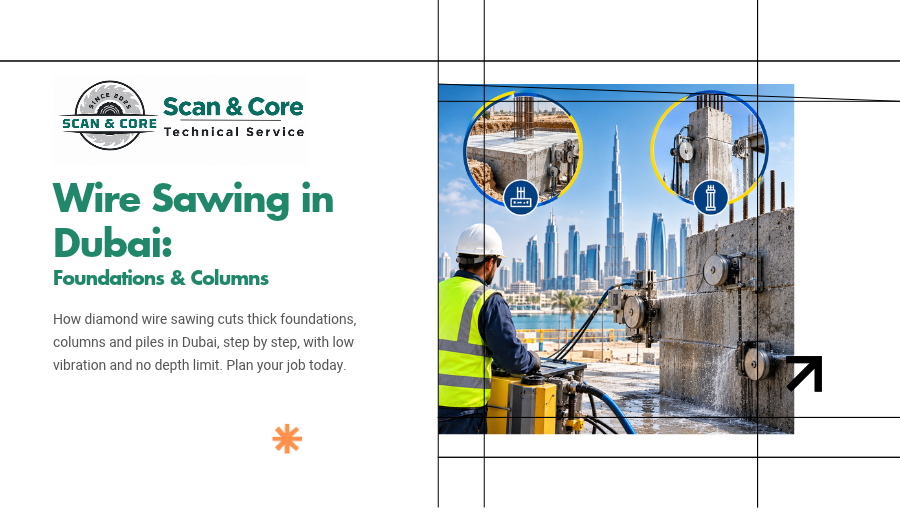
A wire saw uses a steel cable fitted with diamond-impregnated beads. The wire is looped around or through the concrete, then pulled at high speed by a hydraulic drive unit. As it runs, the diamond beads grind through concrete and steel reinforcement together.
Because the wire wraps around the element, there’s no blade size limiting the depth. If you can get the wire around it, you can cut it.
How a wire sawing job works
Step 1: Survey and scan
The crew assesses the element, its size, its reinforcement and what’s around it. GPR concrete scanning maps rebar, post-tension cables and embedded services along the planned cut line, so the route avoids anything that shouldn’t be cut.
Step 2: Engineering check and temporary support
Cutting a column, beam or foundation changes how loads move through the structure. A structural analysis confirms the cut is safe and specifies any temporary propping. Props go in before cutting starts.
Step 3: Plan the cut and the lift
The crew decides where to cut and how big each block will be. This depends on the lifting equipment available and the route out of the building. A single block of reinforced concrete can weigh several tonnes, so the lift plan matters as much as the cut.
Step 4: Drill access holes
If the wire can’t simply wrap around the outside of the element, core holes are drilled through it so the wire can be threaded where it needs to go. This is how wire saws cut openings in the middle of thick walls or slabs.
Step 5: Set up the drive unit and pulleys
The hydraulic drive unit is anchored in place. Guide pulleys are fixed to direct the wire along the cut line and keep it under the right tension.
Step 6: Cut wet
Water is fed onto the wire throughout the cut. It cools the diamond beads, flushes out the cutting paste and keeps dust down. As the wire cuts deeper, the drive unit moves back along its rail to keep tension constant.
Step 7: Support, lift and remove
Before the final section of the cut, the block is supported or rigged to a crane or lifting gear so it doesn’t drop or shift. Once it’s free, it’s lifted out and removed, often for crushing and recycling.
Step 8: Make good
The cut faces are smooth and flat, ready for new connections, strengthening or finishing with little extra preparation.
Where wire sawing is used in Dubai
- Pile cropping. Trimming piles to the right level before pile caps are cast, without shock damage to the pile below.
- Foundation and raft removal. Cutting thick foundations into liftable blocks during redevelopment.
- Column and beam removal. Taking out structural elements during refurbishment, once temporary support is in place.
- Openings in thick walls. Retaining walls, core walls and basement walls too thick for a wall saw.
- Transfer structures. Cutting heavily reinforced transfer slabs and beams in podiums and towers.
- Marine and infrastructure work. Quay walls, bridge elements and structures where a diamond wire can work in water or around odd shapes.
Why choose wire sawing?
No depth limit. The wire wraps around the element, so thickness isn’t a barrier.
Any shape. Curved, angled and irregular cuts are all possible.
Low vibration. There’s no impact, so the concrete you keep isn’t cracked or shaken loose. That matters in occupied buildings and next to sensitive equipment.
Remote operation. The operator controls the saw from a distance, which keeps people away from the cut line.
Clean faces. Smooth, accurate cuts that need little finishing.
Quieter than breaking. Far less noise than hydraulic breakers, which helps when working near tenants or neighbours.
When another method is better
Wire sawing isn’t always the fastest or cheapest option. For walls and slabs within the depth range of a large wall saw, roughly up to 700mm, track-mounted wall sawing is often quicker to set up. For long, straight cuts on ground slabs, a floor saw is usually more efficient.
Wire sawing earns its place when the element is too thick, too large or too awkwardly shaped for anything else.
Plan your wire sawing job with Scan and Core
Scan and Core provides concrete cutting, GPR scanning and structural assessment across Dubai and Abu Dhabi. For heavy elements, we scan the cut line, coordinate with your engineer and plan the cut and lift as one job.
Contact Scan and Core to discuss your project, or call +971 56 861 9006.